
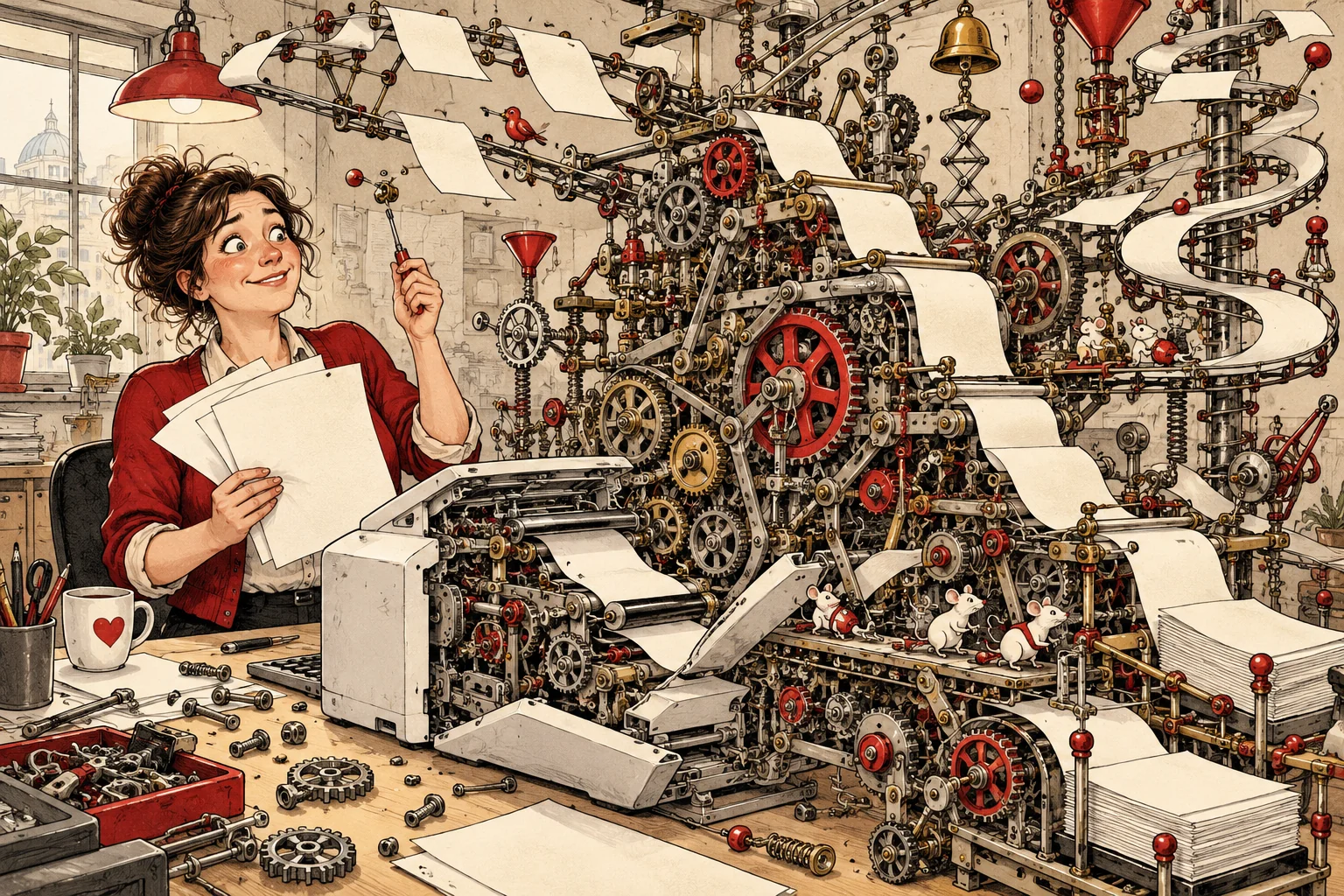
YOU: Print.
PRINTER: Paper jam.
YOU: Where?
PRINTER: Open rear panel.
YOU: You are against the wall.
PRINTER: Open rear panel.
You move the printer. Its cable is shorter than its expectations. A cup falls over. You open the rear panel and find no paper.
YOU: There’s nothing here.
PRINTER: Close rear panel.
YOU: Right.
PRINTER: Paper jam.
Professional development
You consult the small diagram. It depicts a cheerful hand reaching into the printer at an angle available only if the hand has resigned from the arm.
You attempt the angle. The printer contains several pieces of plastic you are permitted to touch and one piece you are specifically forbidden to touch. They are the same color.
YOU: Which one?
PRINTER: Refer to manual.
The manual is online. You find the model number, which is printed on the back beside the panel you have just closed.
You reopen it. The sticker has a model number, a serial number, and a barcode. You enter the serial number. The website finds no printer. For a moment, this feels like useful agreement.
The website offers you a choice between the manual, a setup guide, and a troubleshooting guide. You choose troubleshooting because trouble is the most established part of your relationship.
The guide asks whether the printer is switched on.
You look at the illuminated error message.
You select Yes with unnecessary force.
The successful intervention
A colleague approaches.
“Is it working?”
You explain that it is working as a display for the words Paper jam.
“Have you tried turning it off?”
You have. You do it again because the colleague is watching, and repeating a failed action can feel more reasonable in company.
The printer restarts. It makes several promising noises. You both watch it with the attention usually reserved for a small animal emerging from anesthesia.
PRINTER: Ready.
“There you go,” says the colleague.
They walk away.
YOU: Print.
PRINTER: Paper jam.
You consider calling them back but cannot face the question about whether you have tried turning it off.
A change in requirements
Eventually you find a tiny scrap of paper beneath a roller. It is small enough to be legally described as lint. You remove it with the satisfaction of a surgeon completing a difficult procedure.
PRINTER: Ready.
YOU: Print.
PRINTER: Replace cyan cartridge.
YOU: The document is black text.
PRINTER: Replace cyan cartridge.
YOU: There is no blue.
PRINTER: Replace cyan cartridge.
You open the settings and select black and white. The printer acknowledges the setting and continues to require cyan. It is committed to having options.
The replacement cartridge is in the supply cupboard. You find two cartridges for a printer the office no longer owns, a cartridge whose box is open but whose emotional status is unclear, and a packet of labels nobody has used since the staff retreat.
You borrow a cartridge from another department. You apologize for interrupting. You explain that you only need three pages.
The phrase “only three pages” has become a summary of your innocence.
The document arrives
With the cartridge installed, the printer produces the first page.
It is beautiful. The text is crisp. You feel a brief, disproportionate affection for the machine.
The second page contains the first half of the second page. The third contains the second half. The margins have been adjusted by a setting you did not know existed.
You open Print Preview.
The preview looks perfect. The printer would prefer to explore the possibilities.
A notification appears on your computer: Print job complete.
You disagree, but no response field is provided.
You change the scaling, print again, and finally receive three usable pages. You stack them neatly. It is now twenty-seven minutes after the original request.
The colleague returns.
“Sorted?”
“Yes.”
“Good. These things are usually simple.”
You hand them the pages rather than explain your new qualifications.
The closing message
As you leave, the printer displays a warning.
PRINTER: Low paper.
You look at the tray. There is enough for several more jobs. You would like this to remain someone else’s fact.
Then you remember the next person approaching the machine, innocent and holding a file containing ordinary text.
You add paper.
The printer says Ready.
You nod to it, as one professional to another.
Neither of you means it.