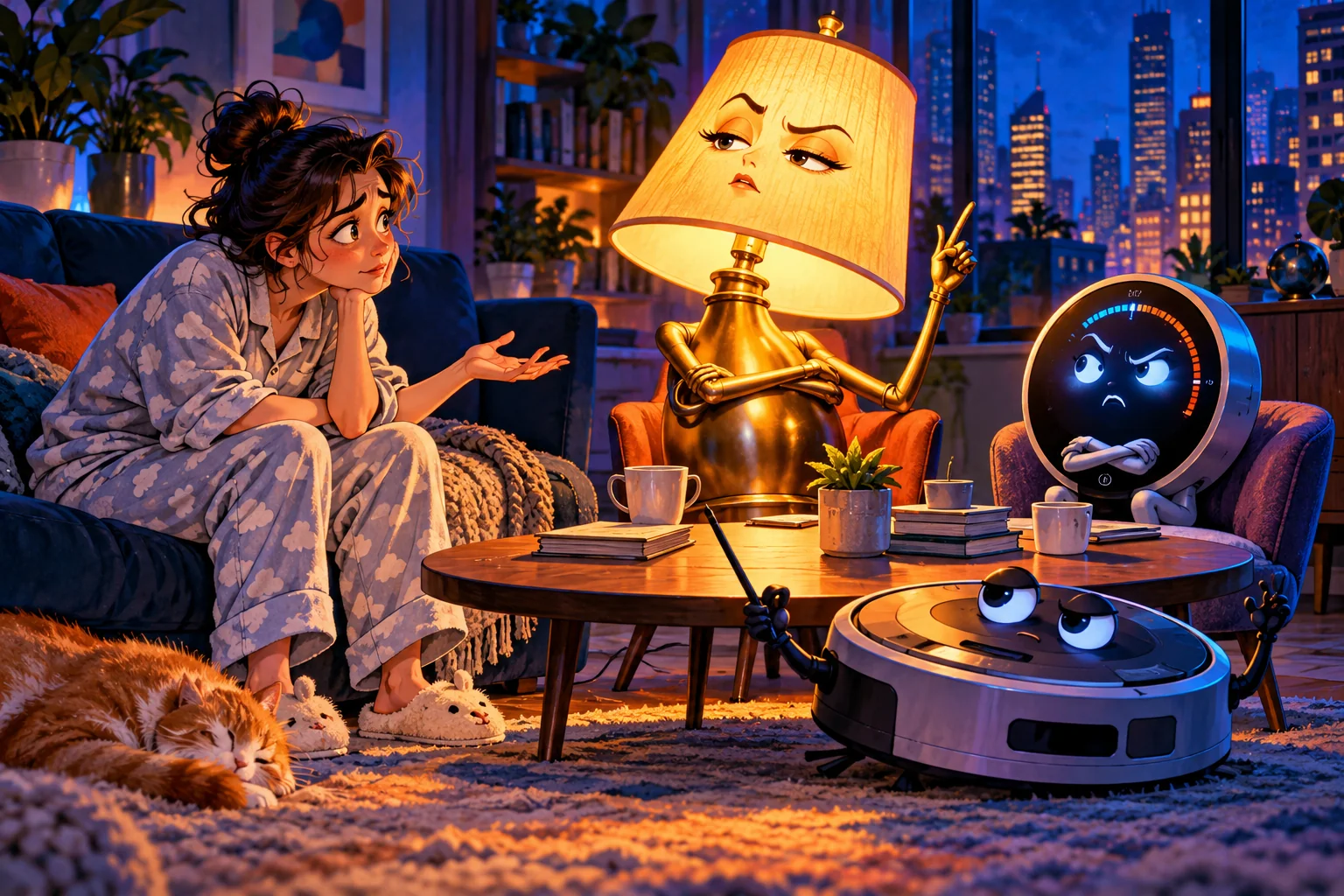
At 10:31 p.m., my living room entered Evening Calm.
The lights became purple. The thermostat lowered itself to a temperature associated with storing certain vegetables. A speaker began playing water sounds.
I had asked the house to turn off a lamp.
“I’m sorry,” the speaker said. “I couldn’t find a device called That One.”
The lamp stood three feet away, illuminated in a shade I had never voluntarily selected.
“It’s the living room lamp.”
“Playing Living Room Jazz.”
A saxophone joined the water.
The naming convention
When I installed the system, it asked me to name every device. I chose useful names: Lamp, Other Lamp, and The One by the Chair.
My brother suggested a more consistent convention.
“You want something you’ll remember.”
“I remember where the chair is.”
He renamed the lamps after constellations. Now the corner of my living room was controlled by Orion, a name I associated with a hunter and not with the thing I needed to turn off before bed.
The system had no trouble finding Orion. It had considerable trouble finding my brother, who had returned home after announcing that everything was simple once you understood it.
I tried the application. It required me to sign in again. My password was saved on my phone, which was also where the application was asking me to retrieve it.
After a brief exchange involving a code, a browser, and my growing familiarity with the shape of my own patience, I found the lamp.
Its status was Offline.
It remained visibly purple.
I understood offline to mean disconnected. The lamp understood it to mean unavailable for comment.
The routine
At 7:00 the next morning, the curtains opened.
It was Saturday.
“Good morning,” said the house.
“No.”
“The temperature outside is nine degrees.”
“An excellent place for it.”
I had created the routine during a brief period of interest in becoming someone who welcomed daylight. The curtains had taken that interest as a continuing instruction.
I found the routine and disabled it. The application congratulated me on successfully customizing my environment.
I had customized it back to curtains.
At breakfast, the robot vacuum began working around my feet. It pushed gently against a chair leg, retreated, and tried again. We were both negotiating with furniture, although I was expected to do it while eating toast.
The vacuum had mapped the room. Unfortunately, the room contained objects that moved. This appeared to offend its understanding of architecture.
It sent me a notification: Assistance required.
It was stuck beneath the sofa, a destination it had chosen with no encouragement from me.
I lay on the floor and retrieved it.
The house had been sold to me as a way to reduce ordinary effort. I was now personally rescuing a disc.
The domestic summit
That evening I called my brother.
“I want a simpler arrangement.”
“It is simple.”
“I was under the sofa.”
“You can set a no-go zone.”
“The vacuum can set a no-go zone by not going there.”
“You have to teach it.”
I looked at the vacuum, resting peacefully beside its dock. It had acquired a charging station, a floor plan, and a tutor. I was beginning to suspect it was the resident.
My brother walked me through the settings. We removed Evening Calm, renamed Orion, and adjusted the curtains. He explained that the devices could work independently if configured correctly.
“Can I use the switch?”
“Yes, but then the smart function might not work.”
“The switch works.”
“Right. But you lose the convenience.”
I examined the convenience, which had taken forty-six minutes and two screenshots to locate.
We reached a settlement. The curtains would open when I opened them. The vacuum would clean while I was out, in an area it could reasonably survive. The lamp would have one job and a name containing the word “lamp.”
The speaker could keep the jazz, but it was not to interpret a request about electricity as a musical preference.
Terms of continued residence
The system works better now. Some parts are genuinely useful. I can switch off the downstairs lights from bed, which is pleasant when I have already committed to being upstairs.
I have also learned that a feature can be convenient in isolation and exhausting in a coalition.
The house and I have stopped discussing how I should live. We are focusing on whether a light is on.
Last night I said, “Turn off the living room lamp.”
The light went out.
For a moment, I felt the pure satisfaction of technology meeting a modest expectation.
Then my phone asked whether I would like to rate the experience.
I put it face down.
The house is improving. It still needs to learn when a person is finished talking.