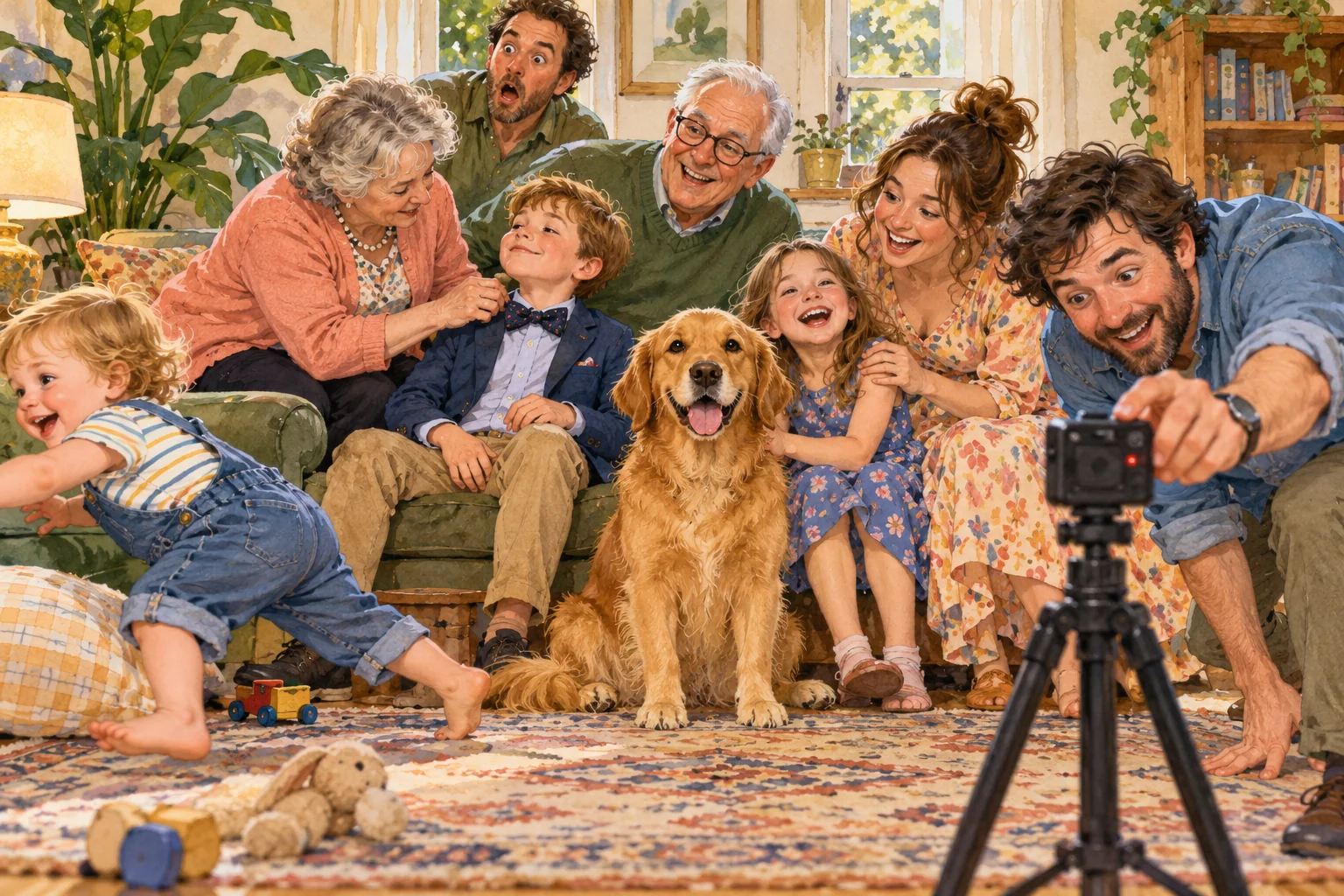
My sister said we should take a quick family photo before lunch. She said this in the tone of someone suggesting we open a window.
There were seven of us, plus a dog. The dog was ready immediately. He sat in the middle of the lawn with his chest out and an expression that said he understood the importance of having a usable image for the Christmas card.
The humans needed preparation.
Dad wanted to know whether this was a proper photo or just a phone photo. These are different branches of photography to him, although both now involve my sister's phone. A proper photo requires him to tuck in his shirt. A phone photo permits him to retain his personality.
Mum said it was just a quick one, then tucked in his shirt herself.
The arrangement
We began with tall people at the back. This immediately created a shortage of people at the front, since everyone over thirteen believed they belonged in the tall category.
My brother crouched. Mum said he looked uncomfortable. He stood up. Mum said she couldn't see me. He crouched again, this time with an expression suggesting the family had disappointed him in a new way.
My sister moved our nephew next to Grandma. He moved next to the dog. She moved Grandma next to the dog. The dog, correctly reading the situation, stayed exactly where he was.
“Everyone just look natural,” she said.
Dad placed a hand on his hip. He has never placed a hand on his hip outside a photograph. In photographs, he becomes a man about to unveil a boat.
Grandma asked whether she should take her glasses off.
“Whatever you normally do,” said my sister.
“I normally wear them.”
“Then wear them.”
“But will they reflect?”
This was a good question. We all turned toward her glasses to inspect them, producing a photograph of six people apparently concerned about Grandma's vision.
The timer
My sister balanced her phone on a garden chair and set the timer. Then she ran into the gap we'd left for her.
We hadn't left a gap. We'd left an understanding that a gap would exist when she needed it. My brother moved sideways, I stepped onto Dad's shoe, and the nephew interpreted the countdown as permission to sprint.
The first photo showed my sister entering the frame at speed, one small person leaving it, and the dog looking excellent.
“That's fine,” said Dad. “We've got one.”
My sister zoomed in on his face.
“Your eyes are closed.”
“I know what I look like.”
We tried again. This time she gave the child an important job: stay still until the beep.
“What beep?” he asked.
“The phone beep.”
“I want to see.”
He went to see. In the second photo, his face occupied about eighty percent of the available space. The rest was the dog, who had not yet produced a bad angle.
My brother offered to hold the phone and take the picture himself.
“But then you won't be in it,” said Mum.
“I could send you an older photo of me.”
Mum did not appreciate this solution, although from an engineering perspective it had considerable merit.
Normal smiles
We reached the stage where everyone was physically present but nobody looked pleased about it.
“Smile normally,” said my sister.
My brother smiled as though he had just been told the cost of repairing a roof.
Dad said cheese. He said it once, at an ordinary speaking speed, and then waited with his mouth open for the camera to do its work.
Grandma had a lovely smile until Mum said, “Mum, that's lovely,” at which point Grandma stopped smiling to ask what was lovely.
The nephew had acquired a stick. My sister asked him to put it down. He agreed to hold it behind his back, a compromise that meant he was technically cooperating while still possessing a stick.
Someone wondered whether the phone was actually taking pictures.
Nobody moved to check. We'd invested too much in standing still.
From the kitchen came the smell of lunch. Dad turned his head. So did my brother. The dog did not. He was a professional.
“One more,” my sister said.
We understood “one more” to mean the beginning of the final round of one mores.
The usable one
Then Grandma made a noise. Not a big noise. The sort of noise you make when you've been politely holding a crouching position and a knee has decided the discussion is over.
My brother straightened. Dad caught Mum, who hadn't fallen but had been leaning on him. I laughed. My sister abandoned her instructions. The nephew, sensing a change of management, lifted his stick triumphantly.
The timer went off.
That is the photo Mum put in a frame. Half of us are blurry. Dad's shirt has escaped again. Grandma is looking at my brother with real affection, possibly because he has offered her a chair. The dog is staring straight at the camera, understandably annoyed that his colleagues have let him down.
Whenever someone visits, Mum says, “That's all of us.”
It is, too.
The other thirty-four pictures are much more accurate about our faces and considerably less accurate about the family.