
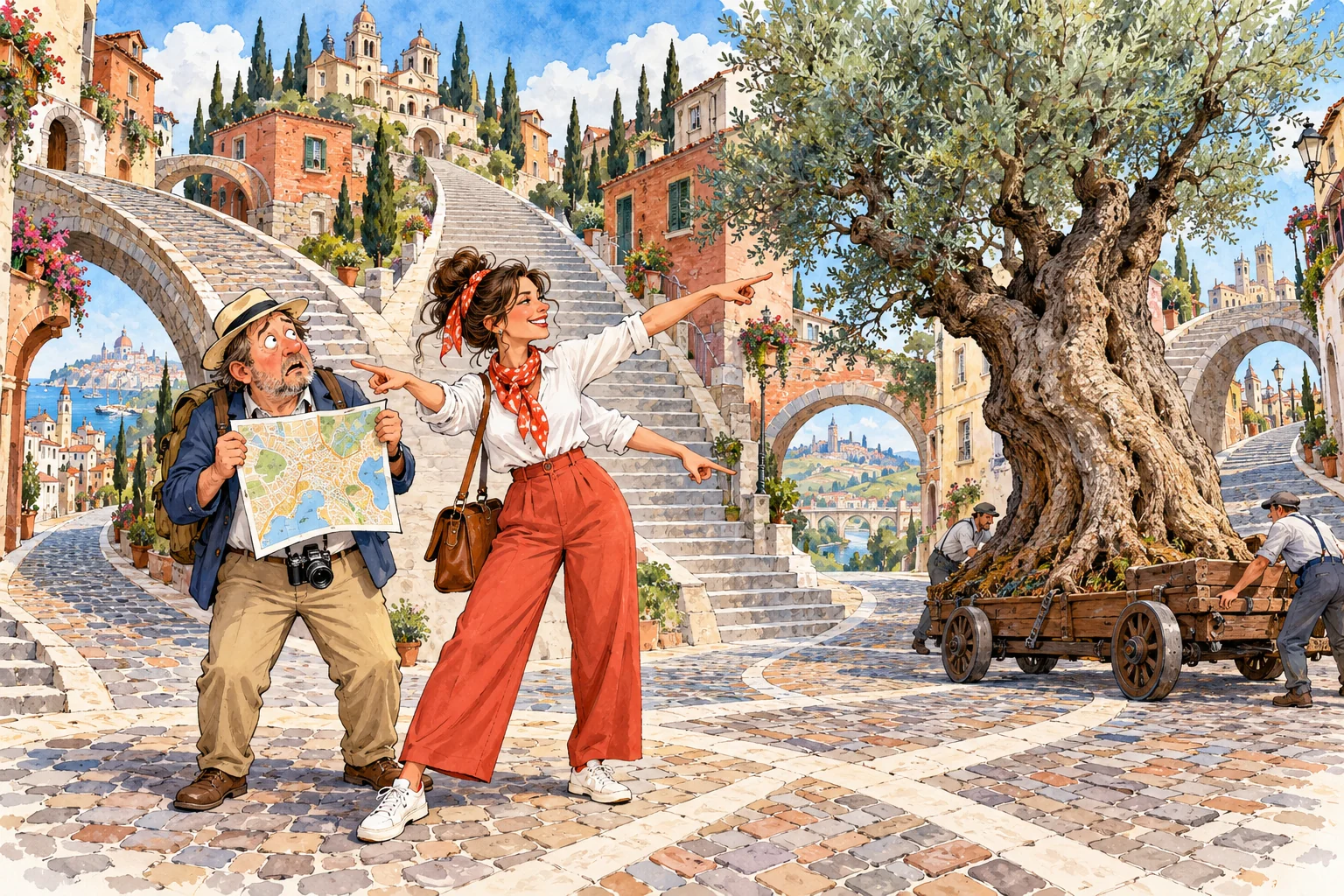
“You can’t miss it,” says the person giving directions.
This is a remarkable thing to tell someone who has already stopped a stranger because they have missed it.
The person is not being unkind. They genuinely believe the place is easy to find. They have lived here for twenty years, have watched the neighborhood change, and possess a private map containing three buildings that no longer exist.
“Go past the old cinema.”
“What is there now?”
“A pharmacy.”
“Then I go past the pharmacy?”
“No, not that pharmacy. The old cinema.”
You are now navigating the area’s cultural memory.
Local knowledge
Every confident direction includes a landmark understood by precisely the person giving it.
“The big tree.”
“The road that bends a bit.”
“Where Peter used to have his shop.”
Peter’s former shop is an especially important feature because it combines a physical location, a personal relationship, and a date you were not present for.
You ask whether it has a sign.
“They changed it.”
“To what?”
The person pauses. This is the first sign of uncertainty. It will not affect the confidence of the remaining instructions.
“Anyway, just go left there.”
Left where? At Peter? At the changed sign? At the pause?
You do not ask. The person is helping, and you have already used two questions. You worry that a third will suggest an objection to the neighborhood.
The helpful expansion
Once they begin, people giving directions often realize they know a better way.
“Actually, don’t go that way.”
They withdraw the route you were carefully storing in your head and replace it with a shortcut involving a car park and a gate that may or may not be open.
“If the gate’s closed, come back around.”
You attempt to establish what around means. They turn their entire body and point through a building.
“Just round there.”
The gesture describes a route available mainly to pigeons.
Then a second local arrives.
“Where are you trying to go?”
You say the name. The second local disagrees with the first. They now discuss which route is better, while you stand between them holding your phone like a visiting official.
They are not arguing about your destination anymore. They are resolving an older dispute about the roadworks.
You learn a great deal about a traffic decision made in March.
The distance unit
“It’s five minutes.”
Five minutes is not a distance. It is an expression of local optimism.
The walk may be five minutes if you know where you are going, take the correct turn immediately, and move at the pace of a person who has no need to study pharmacy signs.
You will be walking at the pace of someone who has just been told that the pharmacy is not the pharmacy.
“There’s a bit of a hill.”
This is another reassuring phrase. A bit of a hill can describe anything from a modest slope to a street where your suitcase acquires political independence.
“Then it’s right there.”
The final right there is always the most distant point in the explanation. It is spoken as though the building has kindly moved closer while you were talking.
Arrival
You thank the person. They say, “No problem,” which is true from their side of the arrangement.
You walk away. Within thirty seconds you have forgotten whether the first turn was before or after the tree. The tree, when found, looks like a tree. It offers no confirmation of its importance.
Your phone suggests another route. You follow it with the guilty feeling of someone disregarding a personal favor.
Eventually you arrive. The building is obvious once you know which building it is.
Later, a stranger stops you and asks where it is.
Something happens to your posture. Your chin rises. You point down the street.
“Oh, that’s easy,” you say.
You have been in the neighborhood for forty-seven minutes. You are ready to serve it.
“Go past the pharmacy.”
“Which pharmacy?”
You smile with the generous patience of a local.
“The one by the big tree. You can’t miss it.”