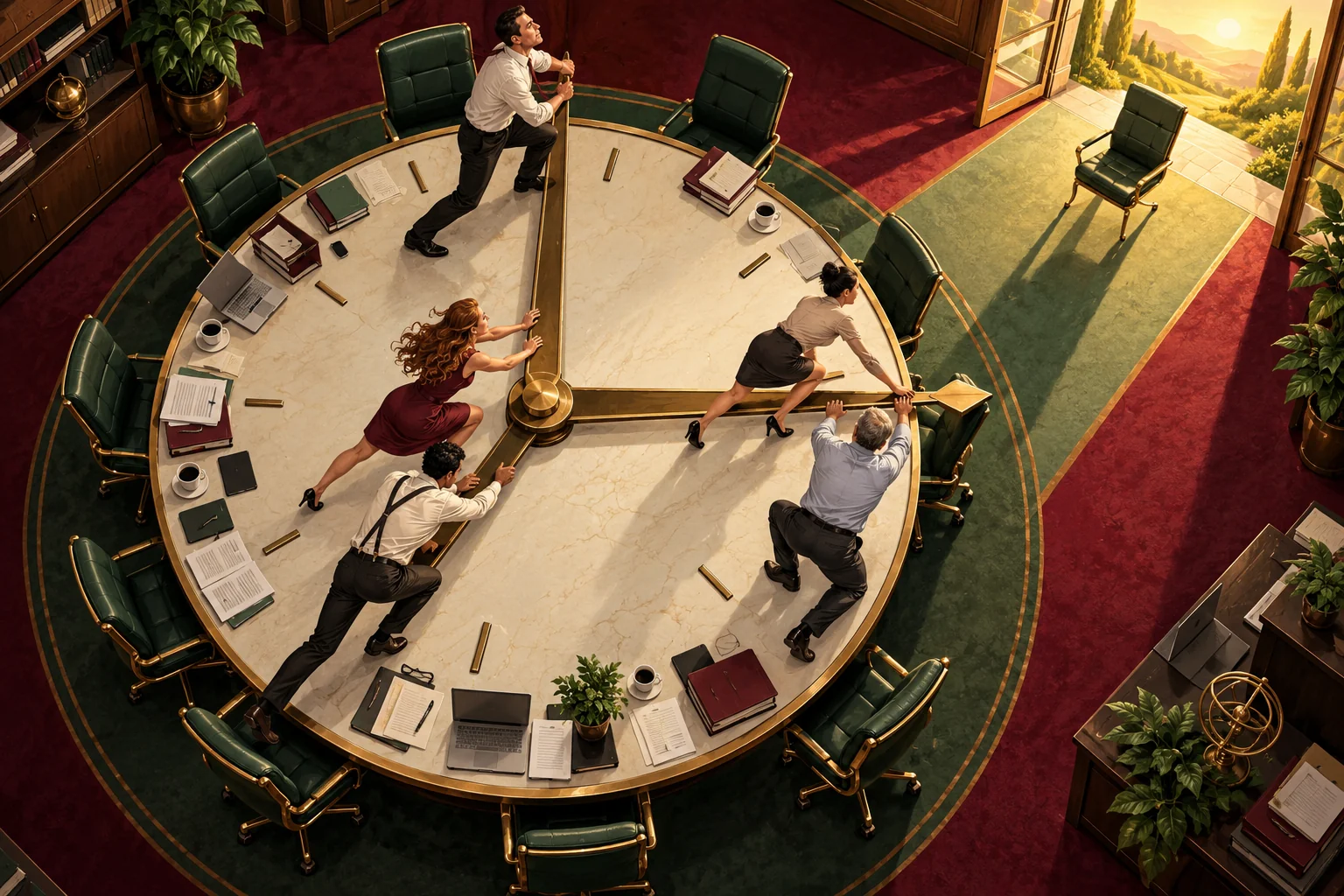
Attendance: Eight people whose calendars indicated that they were free, which was why they were invited to a meeting about having no time.
Purpose: To reduce the number and duration of meetings, with immediate effect once the appropriate discussion has taken place.
Scheduled duration: Thirty minutes.
Actual duration: See item 14.
1. Opening remarks
The chair thanked everyone for making time. Several attendees looked at their laptops in a way that suggested time had been made without their involvement.
The chair emphasized that this would be an informal, practical session. A slide presentation of thirty-one slides was opened.
2. The current problem
There was broad agreement that people were spending too much time in meetings.
The team was asked to provide examples. Nina mentioned the Tuesday status meeting. The chair said that was a useful meeting. Nina mentioned the Thursday status meeting. The chair said that was useful for the people unable to attend Tuesday.
Asked whether the same people usually attended both, the chair said it was important to maintain continuity.
3. Definitions
It was suggested that a meeting be defined as “a scheduled conversation involving more than one person.”
Tom asked whether this included phone calls. Emma asked about conversations at someone's desk. The chair said those didn't count because they weren't on the calendar.
Tom suggested removing meetings from the calendar.
This was recorded as a joke, although Tom asked that it be considered as a proposal.
4. The five-minute delay
The next slide would not advance. Four people offered different keyboard shortcuts. One person said the presentation software had been unreliable since the update. Another said she hadn't noticed a difference.
The software update was discussed for five minutes. No conclusion was reached, although most people felt heard.
5. Meeting-free afternoons
The chair proposed a meeting-free afternoon each week.
Wednesday was rejected because it contained an existing meeting about priorities. Thursday was rejected because of the second status meeting. Friday was rejected because several people left early, and it was felt that protecting their afternoon would be unfair to people whose afternoons still required protection.
Monday was kept under consideration.
6. A smaller attendance list
Nina suggested inviting fewer people.
The chair asked whether anyone present felt they didn't need to be there.
Nobody volunteered. The question had been asked by the person responsible for reviewing their performance.
The chair noted strong engagement.
7. The information gap
Emma suggested sending a written update instead of holding a status meeting.
The chair asked how people could ask questions. Emma suggested replying to the update.
Tom asked whether everyone would read it. Nina said she would read something that allowed her to avoid attending a meeting.
It was agreed that the written-update idea showed promise, but that a short meeting might be needed to explain how it would work.
8. The halfway point
The chair noted that the meeting had reached its scheduled end and asked whether people could stay for “just a few more minutes.”
Three attendees said they had another meeting. The chair suggested that they join that meeting a little late because the current discussion was important.
One attendee left on time. Her name was followed by “left early” in the draft minutes. This was corrected after she pointed out the time.
9. Mandatory agendas
It was agreed that every meeting should have a clear agenda.
Tom asked whether having a clear agenda would mean a meeting could end once the items had been resolved.
The chair said that was the aspiration, but that remaining time could be used for other business.
Tom was visibly careful about his next expression.
10. Other business
The chair asked whether anyone had other business. No one did.
The chair waited because sometimes people needed encouragement.
Nina eventually asked whether the kitchen dishwasher had been repaired. It had.
11. Actions
Emma will write a one-page proposal for written updates. Nina will identify meetings that can be removed. Tom will define a meeting, including edge cases, but excluding jokes.
The chair will circulate the actions, along with a request for comments on the circulation process.
12. The trial
Monday afternoon will provisionally be protected from meetings for four weeks, except where a meeting is necessary.
The definition of “necessary” will be included in Tom's work.
13. Review
A review session will be held to assess whether the trial is saving time.
The only slot available to all attendees was Monday afternoon.
14. Close
The meeting closed after fifty-seven minutes. The chair described the discussion as energizing. No corrections to this description were offered during the meeting.
Post-meeting note: Nina sent a two-sentence update canceling the Thursday status meeting. It took eleven seconds to read. Everyone knew what to do next.
The chair has asked whether this success can be presented at the next team meeting.