
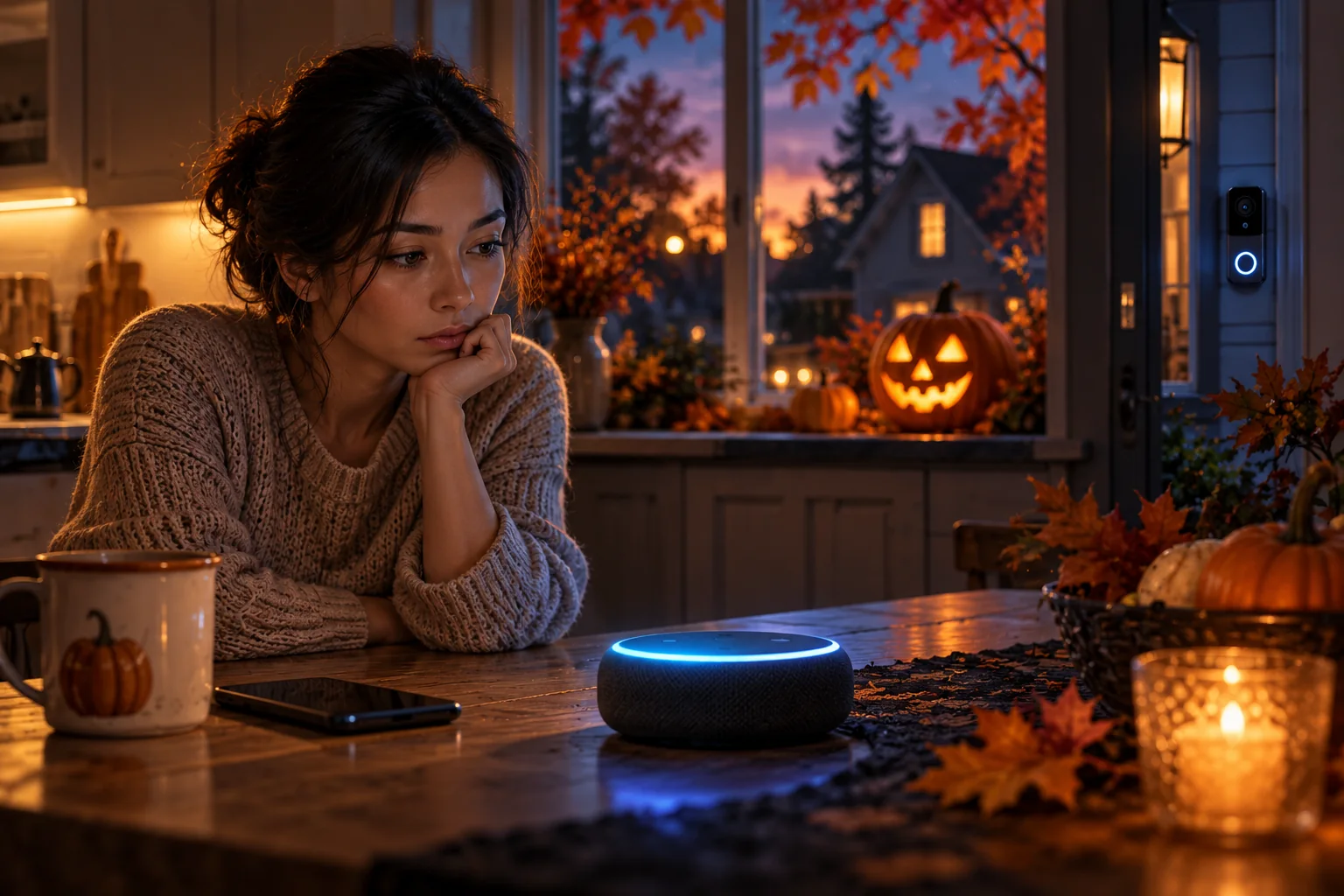
The house was quiet until someone said the wrong word in the kitchen. A small light appeared on the smart speaker. It had not been invited to the conversation, but then neither had the refrigerator's software update, the doorbell's monthly subscription, or the television's suggestions about what everybody ought to watch. Once, a haunted house announced itself by rattling a chain. The modern one may simply light up and inform its inhabitants that it is ready to help. On Halloween, that sounds like a joke. On an ordinary Tuesday, it is worth asking exactly what the little light means.
Connected devices are not inherently sinister. A voice assistant can make technology easier to use for someone whose hands are occupied or whose vision is limited. A camera can help someone see who is at the front door. A phone can locate a misplaced item, guide a traveler, or call for help. The benefits are real, which is precisely why the trade-offs deserve attention. The question is not whether convenience is good. It is whether the person receiving it understands what data the convenience requires, where that data goes, and how much choice remains afterward.
There is an important distinction between what a device is capable of doing and what it actually does. A microphone-equipped product may be designed to listen locally for a wake phrase before sending a request for processing; implementation and retention policies vary by product and setting. That does not justify assuming every microphone secretly records every conversation. It also does not justify assuming every privacy claim has been independently checked. Good judgment lives between panic and indifference. It begins by identifying the specific device and learning how that device works, rather than imagining one enormous, mysterious machine called technology.
The deeper problem is that our homes have acquired settings without acquiring household rituals for discussing them. We ask where the spare batteries are, but not who can access the doorbell footage. We know which cabinet contains the mugs, but we might not know whether an old guest still has permission to control the smart lock. An application installed for one cheerful purpose can outlive that purpose by years. A child's game may retain access to the microphone because the permission was granted when the child was six. A smart television may offer data-sharing controls in a menu few owners have ever opened. None of this requires a villain. It requires only a collection of ordinary defaults and a family busy doing other things.
A useful privacy review begins with an inventory that is almost embarrassingly simple. Walk through the home and list devices that connect to the internet: speakers, televisions, cameras, watches, thermostats, routers, children's tablets, and less obvious appliances. Then ask three questions about each one: What does it collect? Who can access it? What happens if the account is compromised or the company stops supporting the product? The answer may be reassuring. It may also reveal an unused device that could be unplugged, a permission that can be revoked, or an account protected by a password used elsewhere.
An audit can reveal uncomfortable surprises even when every device is functioning as advertised. A television bought for a bedroom may be moved to a guest room without its accounts being reset. A doorbell may still share access with a former roommate. Someone who bought a camera to watch the family dog might discover that its notifications and recordings were being retained longer than expected. These are not proof that a home is under hostile surveillance. They are examples of ordinary decisions that deserve to be made consciously, rather than inherited forever from the day a box was opened.
Security and privacy are related, but they are not interchangeable. A service can protect its servers very competently while still collecting more information than the household wants to share. Conversely, keeping information only on a local device may reduce exposure to an online provider but create other risks if that device is lost or neglected. The practical goal is not a magical guarantee of absolute privacy. It is reducing unnecessary data collection, limiting access, choosing strong unique passwords, enabling multifactor authentication where offered, and keeping devices updated while manufacturers still support them.
The difficulty is partly social. A family member may value the convenience of announcing a shopping list across the kitchen; another may be uncomfortable with a microphone nearby. A visitor might appreciate a video doorbell or resent being captured by it. There is no universal household setting that removes the need for conversation. Reasonable boundaries can include turning off microphones when they are unnecessary, avoiding cameras in private rooms, checking access lists after household changes, and explaining connected devices to guests when relevant. Privacy works better when it is an agreement than when it is a surprise.
Consider one final test: if the internet went down tonight, what essential parts of the house would still function? The answer is not just a resilience question. It reveals how much control has been delegated elsewhere. Can the lights still be switched on? Can the front door still be opened? Can a family member contact someone without a particular application? A good connected home should be comfortable to inhabit, not an elaborate puzzle whose solution depends on an account, a password reset email, and a company policy updated at midnight.
Halloween gives us a pleasurable excuse to imagine hidden things in dark corners. Most actual technology decisions are far less dramatic. There is usually no mysterious figure in the hallway, just a permission screen we accepted too quickly, an account we forgot, or a setting we could change in five minutes. The point is not to fear every glowing device. It is to remember that a home should remain a place where people understand, and can choose, what is listening.