
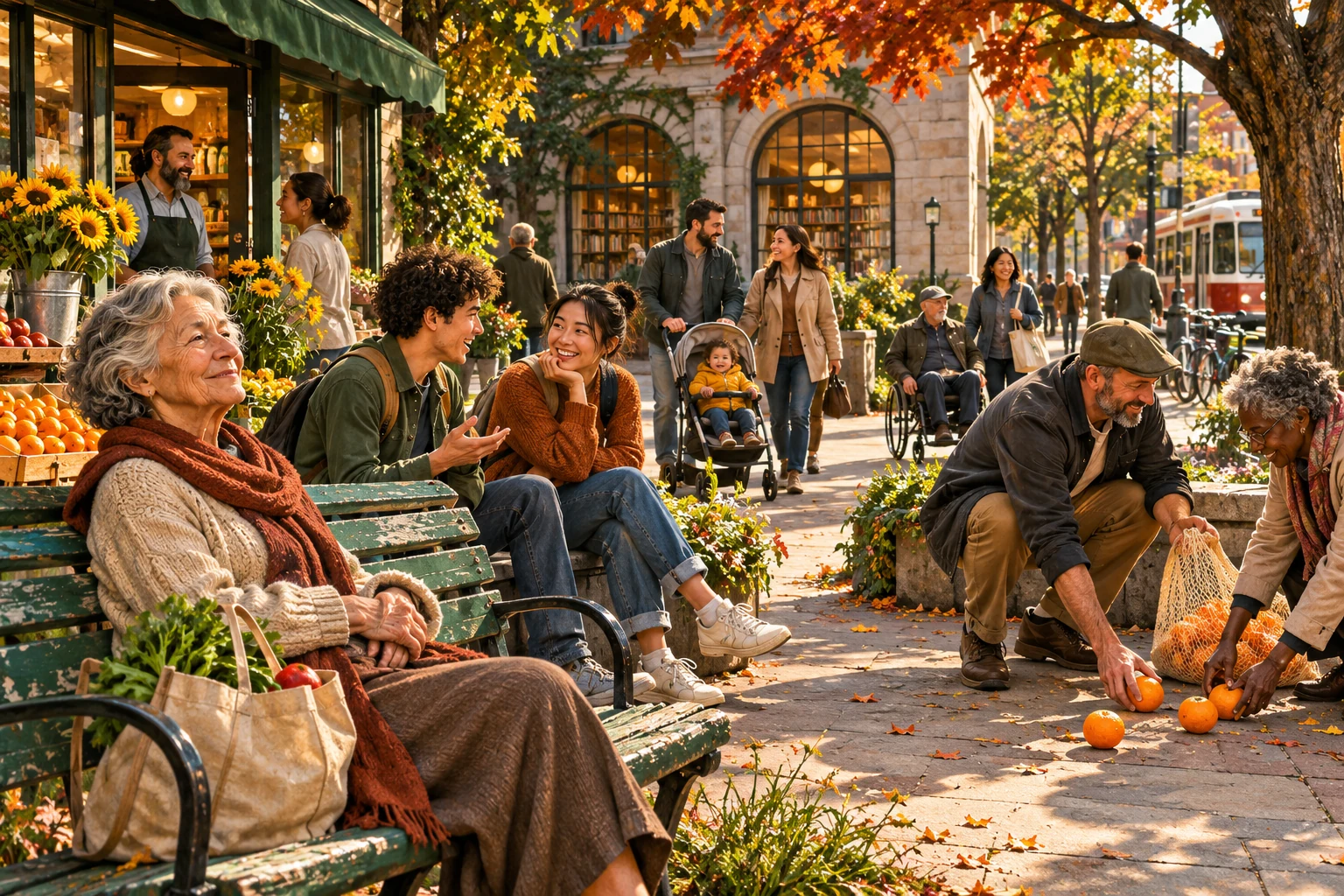
There is a small bench outside a neighborhood grocery where a surprising amount of public life takes place. A woman rests her bags there while waiting for a bus. Two students compare notes before walking home. A man sets down a heavy box to rearrange his grip. Nobody meets there by appointment. The bench offers no event calendar, subscription, or statement of purpose. Its usefulness lies in being available when ordinary lives happen to cross.
We often discuss community as though it were mainly a feeling. We speak of belonging, solidarity, and the value of knowing our neighbors, which are all real and important. But communities also need places where those feelings can be practiced. A sidewalk wide enough for two people to stop talking without obstructing everyone else. A library that welcomes a person who is not buying anything. A public plaza with a little shade, a clean restroom, and somewhere to sit. These physical details shape whether contact between neighbors is easy, awkward, or practically impossible.
Much of modern life is organized around destinations rather than intervals. We travel from a private home to a workplace, store, appointment, or restaurant, and then back again. Each destination has its own purpose and rules. The spaces between them are treated as corridors to move through quickly. Yet many relationships begin without a formal purpose: an ordinary question at a bus stop, a recurring greeting on a morning walk, an offer of help when somebody struggles with a bag. The capacity for such moments depends partly on whether the environment permits people to linger.
A good public place is not necessarily elaborate. Money matters, as do maintenance and safety, but a modest shaded seat may contribute more to daily life than an impressive installation nobody is comfortable approaching. The test is not how remarkable the place looks in a brochure. It is whether children, older adults, people with disabilities, hurried workers, and visitors unfamiliar with the neighborhood can make practical use of it. Public space should allow people to participate without having to prove that they belong there.
The same principle applies to cultural and event venues. A convention center can host thousands of scheduled participants, but the experience of welcome begins in smaller details: a clear entrance, readable signs, a place to pause, a quiet route away from the crowd. An event may be remembered for its speaker or exhibition; the conditions that let guests move confidently through the building become part of the memory without demanding attention. Good design and good operations make space for social life to happen.
There are trade-offs, of course. A bench needs cleaning and occasional repair. A plaza must be maintained. Noise can carry, and people may disagree about who uses a space and how. Accessibility improvements require decisions about routes, surfaces, and budgets. These are not reasons to give up on shared places. They are reasons to approach them as ongoing responsibilities. A public space can be open in a legal sense while remaining unwelcoming in practice. Keeping it useful calls for listening to the people who spend time there, not merely the people who approved its construction.
If you want to understand a neighborhood, try observing where people naturally pause. Watch the entrance to a library, the corner near a school, the walkway between a park and a grocery. Where are people improvising a seat? Where do they avoid crossing because the light changes too quickly? Which small patch of shade fills every warm afternoon? These patterns suggest needs that a formal survey might miss, though observation cannot tell us what people want without asking them. A few thoughtful questions can turn a guess into a better decision.
Small improvements can be a form of hospitality. A curb ramp that actually aligns with the crossing tells a visitor they were expected. A well-placed bench tells someone they may rest without apology. Clear wayfinding tells a newcomer that the place does not require a private insider's map. None of these gestures manufactures friendship, but each removes friction from the possibility of meeting another person as an equal.
By late afternoon the bench outside the grocery is empty. Its paint has worn on the edges, and the wooden slats need attention before winter. It has no record of the conversations it helped begin. Tomorrow somebody may use it to tie a shoe, wait for a friend, or help a stranger gather spilled oranges. That modest future is worth caring for. A neighborhood is not only the buildings its people own. It is also the small amount of room they make for one another.