
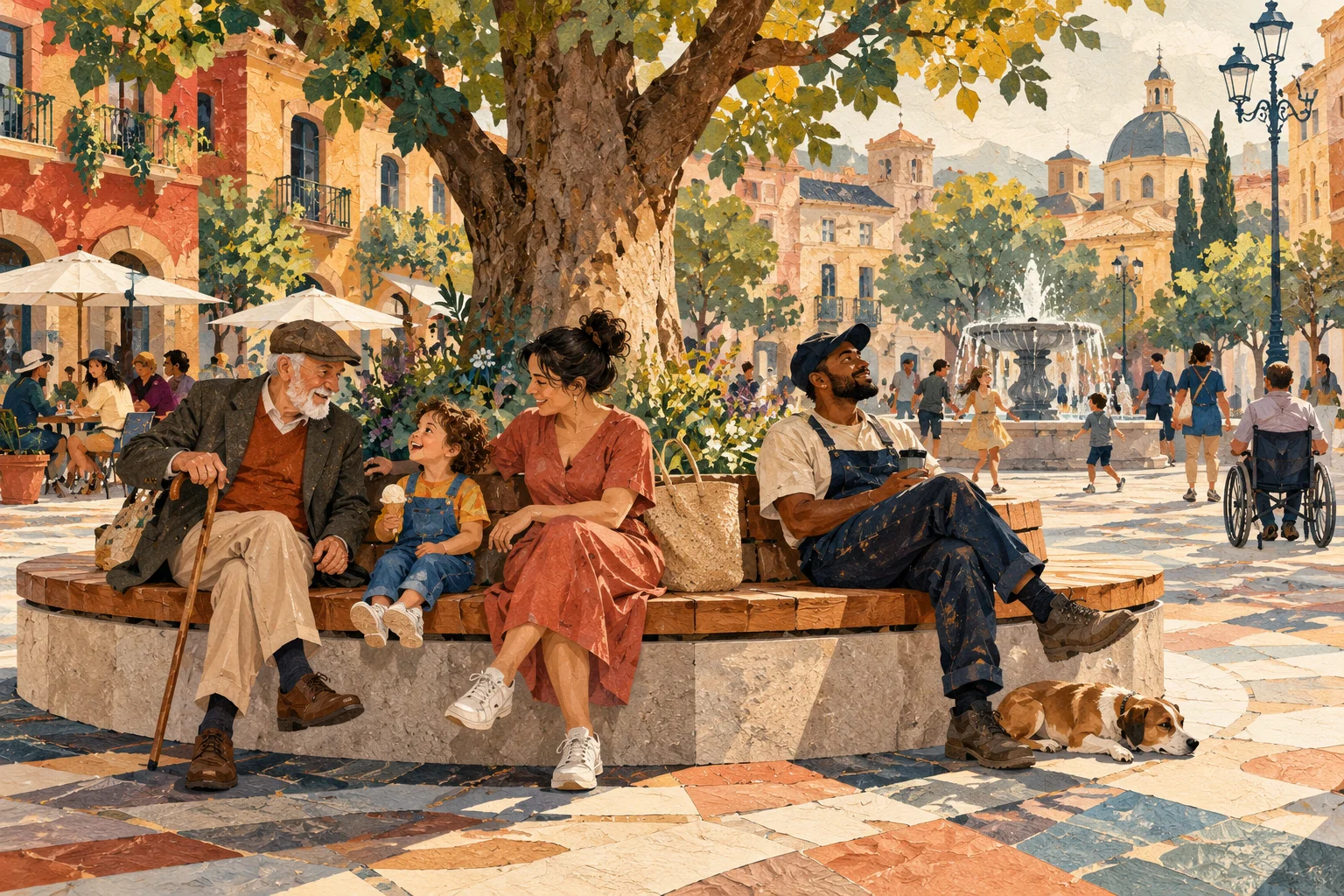
You learn something about a city when you need to sit down.
Perhaps you are carrying a child, waiting for someone, managing a tired knee, or simply hoping to eat a sandwich without purchasing the right to occupy a chair. Suddenly the street becomes a different map. The distances remain the same. The useful places change.
A bench is small compared with a transit system or a housing policy. It does not solve the city’s large problems. But it communicates a practical idea about public life: you may pause here, even if you are not buying anything.
That is a surprisingly substantial message for an object made of slats.
Moving through a place is only one use of it
Cities need routes. People and goods have to move. A public space also needs to accommodate the people who are not currently moving.
Waiting, resting, talking, observing, and caring for someone are ordinary activities. A street designed only for flow can make them feel like errors in the system.
A seat changes that. It turns a location from something to pass through into somewhere you can spend time. Shade, shelter, lighting, and a nearby destination affect whether the seat is actually useful.
The placement matters too. A bench beside a roaring service area offers a different experience from one facing a garden or a lively square. A seat can be technically present and practically uninviting.
Think of a person waiting for a ride, an older neighbor walking to a shop, or a parent whose child has decided that the pavement is an excellent place to reconsider the day. A small opportunity to pause can make the surrounding route more usable.
This is a design judgment, not a claim that every street needs identical furniture. The context should shape the choice.
A seat can invite or ration belonging
Public furniture makes choices visible. Who can use it comfortably? Who can reach it? Is there space nearby for a mobility device or a stroller? Does its design support different bodies and different ways of resting?
Some seats are shaped mainly to prevent certain uses. Others prioritize ease of maintenance, appearance, or a particular pattern of circulation. These objectives can conflict.
It is reasonable for a city to consider safety and upkeep. It is also reasonable to ask whether an exclusionary design addresses a problem or merely moves people elsewhere. Furniture cannot substitute for services, housing, or an honest policy discussion.
A space can feel public while quietly requiring a purchase. Café seating is welcome and useful, but it does not provide the same arrangement as a seat anyone can use. Both can coexist. The distinction should remain visible.
When access to rest depends on spending, the city offers different experiences to people with different resources. You do not need a complicated theory to notice that. Try walking through a busy district with no desire to enter a shop and look for somewhere to stop.
Good intentions still need maintenance
Installing a bench is not the same as keeping a place usable.
A broken surface, poor drainage, accumulated rubbish, or an obstructed path can change the experience. So can a lack of shelter in a location where weather regularly makes sitting unpleasant.
Maintenance deserves attention during planning rather than being treated as the department that inherits the photograph after the opening ceremony. Materials, repair access, cleaning, and responsibilities all matter.
Ask who will notice a problem and how it will be reported. A beautiful object with no clear maintenance owner can become an attractive place to write “unfortunately” in a complaint email.
For a small local project, observing use can be valuable. Which seats are occupied? At what times? Who seems unable to use them? Are people improvising seats somewhere the design did not expect?
These observations do not replace professional accessibility review or required standards. They add a view of everyday life that drawings alone may not capture.
Let ordinary comfort count
Urban ambition often favors large visible changes. A landmark, a new district, a dramatic structure: these are easy to explain in a presentation.
Comfort is quieter. It might be a place to rest halfway along a route, a tree that shades the afternoon side, a surface that stays usable after rain, or enough room beside a seat for someone who is not sitting on it.
The benefits may resist a grand slogan. That does not make them trivial.
As residents, we can ask specific questions about public space rather than only describing it as attractive or unattractive. Where can people pause? Who is missing from the design? What happens in bad weather? What needs repair?
A bench is not a complete social policy. It can still be an honest piece of one: a material acknowledgment that people have bodies, needs, and reasons to remain in a place.
The city lets you sit down. You finish the sandwich. A child points at a bird. The person beside you tells you which bus is late.
For a few minutes, the street is not simply carrying people somewhere else. It is somewhere.