“We need a bulb,” said Nina.
“Then we shall buy a bulb,” said Tom, with the confidence of a man who had never been responsible for the route through a home furnishings store.
They agreed not to take a cart. A cart encouraged ambition. They were two adults with a precise requirement and a car parked close to the entrance. The outing would take twelve minutes.
At the first display, Nina stopped beside a lamp.
“That’s nice.”
“We need the thing that goes inside it.”
“I know. I’m looking.”
Tom looked too, to demonstrate that he was not the sort of husband who opposed looking. The lamp stood beside a cream sofa with three cushions and a throw arranged as though somebody had just abandoned a tasteful crisis.
“Our living room could feel like this,” Nina said.
“Our living room contains us.”
She picked up a cushion.
The basket phase
A basket was a reasonable compromise. It did not have wheels. It was, in Tom’s view, practically a pocket.
The cushion went into it, followed by two candles. The candles were for guests, although their last guests had been offered tea beside a drying rack and had survived with no obvious resentment.
Tom found a wooden organizer for charging cables.
“You said one thing,” Nina reminded him.
“This helps us keep things in one place.”
“So it’s morally one thing.”
“Exactly.”
They spent seven minutes looking at baskets to put beside the sofa. Tom explained that a basket would solve the problem of the blanket being on the sofa.
“The blanket belongs on the sofa,” Nina said.
“It could belong in the basket when we’re not using it.”
“Then we’d take it out of the basket and put it on the sofa.”
“Yes. That’s the system.”
She nodded. The system had clearly received investment and was no longer accepting public comment.
They chose a basket.
A small change in transport
At the plant display, Nina touched an olive tree.
“I’ve always wanted one.”
“You wanted a bulb forty minutes ago.”
“People can want two things.”
The tree was taller than Tom. It stood in a pot with a finish described as natural, although the price suggested nature had employed a consultant.
“Where would it go?” he asked.
“By the window.”
“That’s where the chair goes.”
“We could move the chair.”
“Where?”
They looked toward the next display, which contained a small stool.
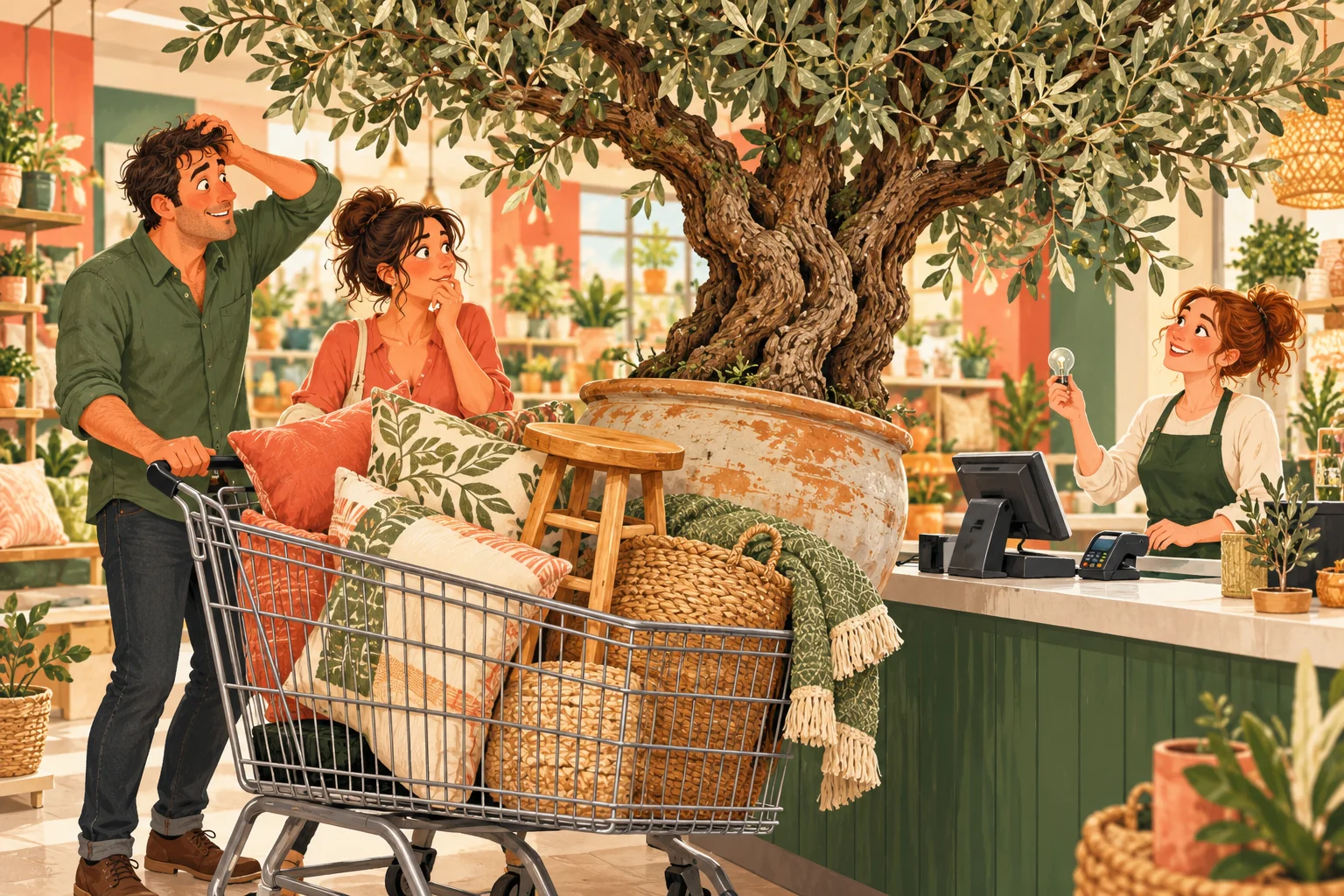
Ten minutes later, Tom returned with a cart. He held it lightly, pretending he had found it in passing and had no personal connection to the development.
The olive tree rode in front. The basket contained the cushion, candles, and cable organizer. The stool rode behind. They looked like a family moving a very small village.
Nina spotted a set of four glasses.
“We have glasses,” Tom said.
“We have three matching glasses.”
“We are two people.”
“What if people come over?”
Tom considered the candle guests, who now required coordinated drinking equipment.
“Fine.”
At the next aisle, he put a kitchen timer into the cart.
Nina looked at him.
“Our timer is on my phone,” he explained.
“Yes.”
“If I use my phone, I start looking at other things.”
“So this prevents distraction.”
“Precisely.”
Neither of them looked at the cart.
The bulb department
They eventually reached the lighting aisle, tired and mildly hungry.
“What fitting is it?” Nina asked.
Tom took out his phone. He had photographed the old bulb before leaving, an act of foresight he now felt should excuse several subsequent decisions.
The photograph showed the bulb beside a coin for scale. The fitting was hidden behind his thumb.
They enlarged it.
They rotated it.
They agreed the thumb was exceptionally well documented.
“I think it’s the small screw,” Nina said.
“Are you sure?”
“No. But I’m sure I don’t want to come back today.”
They bought a pack of small screw bulbs and a pack of large screw bulbs. It was cheaper than admitting the trip had failed its original purpose.
At checkout, the cashier asked whether they had found everything they needed.
“More,” said Tom.
The cashier smiled the patient smile of a person whose workplace had built an entire floor plan around that answer.
Outside, the olive tree did not fit in the car.
It fit after they folded one seat, moved the stool, and placed the basket between Nina’s feet. Its longest branch rested near Tom’s ear. On the drive home, he indicated carefully because the tree was interfering with his understanding of the left side of the world.
“We should have measured,” Nina said.
“The bulb?”
“The tree.”
“Oh. Yes. That too.”
At home, the small screw bulb worked. The room became bright enough to reveal that the new cushion did not match the sofa.
They stood beside it in silence.
“Different lighting in the store,” Nina said.
“Of course.”
The olive tree looked magnificent by the window. The chair had nowhere to go. The cable organizer was slightly too small for the charger.
Tom placed the receipt in the new basket.
“What are you doing?” Nina asked.
“Keeping things in one place.”
She laughed, then sat on the stool.
They ate toast, because neither had remembered lunch. The tree brushed the lampshade. The bulb continued performing the one task for which anybody had originally left the house.
Tomorrow, they would return the cushion.
Just the cushion.