
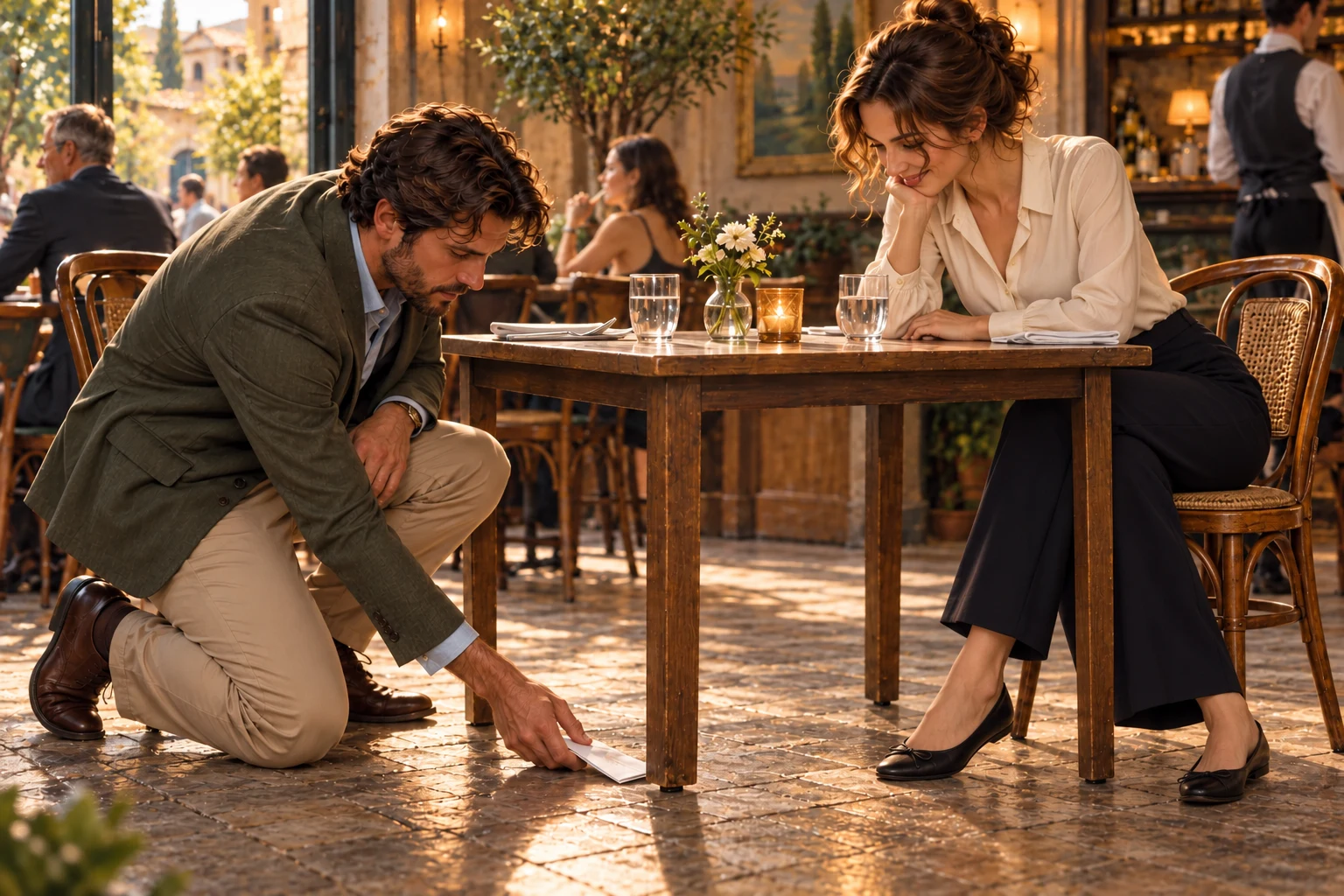
The table announced itself when I put down my water glass. There was a small movement, a soft knock, and a second movement in the opposite direction. I looked at my partner. She looked at the table. We both placed a hand on it, separately, which made the problem appear to stop through the introduction of two unpaid structural supports.
“Is yours moving?” I asked.
“It’s the same table.”
This was useful information, although the corners seemed to be maintaining independent ambitions. I pressed on my side. Her water moved. She pressed on hers. My knife slid a quarter of an inch toward my sleeve. We released it together and sat very still, as though we had encountered an animal that might settle if we did not challenge it.
There were other tables available, but a server had brought us here with confidence, and we had already unfolded the napkins. Moving now would require explaining a problem to another person, which can feel more demanding than spending an evening operating a small lever with your knee.
My partner folded a piece of spare paper and handed it to me. I looked under the table. There were four feet, all apparently committed to the general idea of supporting it. One did not quite meet the floor. I pushed the paper under that one. The table improved immediately and then found a new direction in which to move.
I folded the paper again. It was now thick enough to suggest the beginning of a project. My partner held the table steady while I adjusted it, which made it impossible to tell whether the adjustment had worked. I asked her to let go. She asked whether I was ready. We had developed a procedure that seemed excessive for a surface on which we hoped to eat soup.
The table moved. Less, perhaps. Or differently. We both agreed that it was better, in the hopeful way people discuss a repair while still holding the tool.
The server came to take our order. We removed our hands from the table so we could look normal. It wobbled. He noticed and said he could sort that out. I felt relieved, and also a little displaced, because I had begun to form an understanding of its behavior.
He crouched down, removed my folded paper, and replaced it with a small wedge from his apron. This was a level of preparedness I had not expected. How many tables in the building required an accessory? Did the wedge come with training? I wanted to ask, but he was already standing up and testing the surface.
“There we are,” he said.
It seemed steady. We thanked him with the gratitude usually reserved for a more substantial intervention. He took our order. I put down my menu. The table moved slightly. We watched him walk away before looking at each other.
“That might have been the chair,” I said.
She moved her chair. The table remained where it was. Then I leaned forward, and both water glasses shivered. The table had waited until the authority figure left. I recognized the strategy from several appliances at home.
We attempted to arrange our objects symmetrically. Water on opposite corners. Cutlery in balanced positions. The bread basket in the middle as a stabilizing influence. This had no engineering basis, but it gave our hands something to do while we pretended to discuss the menu.
My partner suggested changing tables. I said we had already ordered, as though the food now contained coordinates. She looked toward an empty table by the window. It appeared stable and was enjoying a pleasant view. Nobody was using it. It had no idea what we were going through.
A couple arrived and were seated there. They put down their drinks without looking at each other. I watched this with an amount of interest that could easily have been misunderstood. The man leaned his elbow on the table. Nothing moved. He was spending an entire ordinary moment without appreciating it.
Our first course arrived. The server placed the plates carefully, then the bread, then a small dish of oil. The oil made us both sit up. A small amount of water on a table was inconvenient. Olive oil had the potential to involve our clothing in the dispute.
We ate with measured movements. If one of us needed to cut something, the other instinctively steadied the table. We became very good at this. Conversation developed pauses in which a person could deal with a difficult piece of food. It was a form of intimacy nobody had mentioned when recommending the restaurant.
When the server returned, my partner asked whether we could move. He said, “Of course,” with no sign that changing the location of two meals would require a major administrative effort. A neighboring table had just become free. He moved our glasses and plates. We moved ourselves. The operation took less than a minute.
The new table was solid. I put my hand on it and pressed gently. My partner told me to stop testing it. She was right. We had been granted a fresh surface and should allow the relationship to develop without suspicion.
Behind us, the server pocketed the wedge and rotated the old table a quarter-turn on the uneven floor. Its feet found a better arrangement with the tiles. He pressed each corner. No movement.
My partner saw me watching. “Don’t,” she said.
“I wasn’t going to.”
We ate the rest of dinner comfortably. When the bill arrived, I put my card on the table and enjoyed the extravagant fact that nothing happened. Outside, my partner said we should come back sometime.
“Yes,” I said. “But perhaps book a particular table.”