
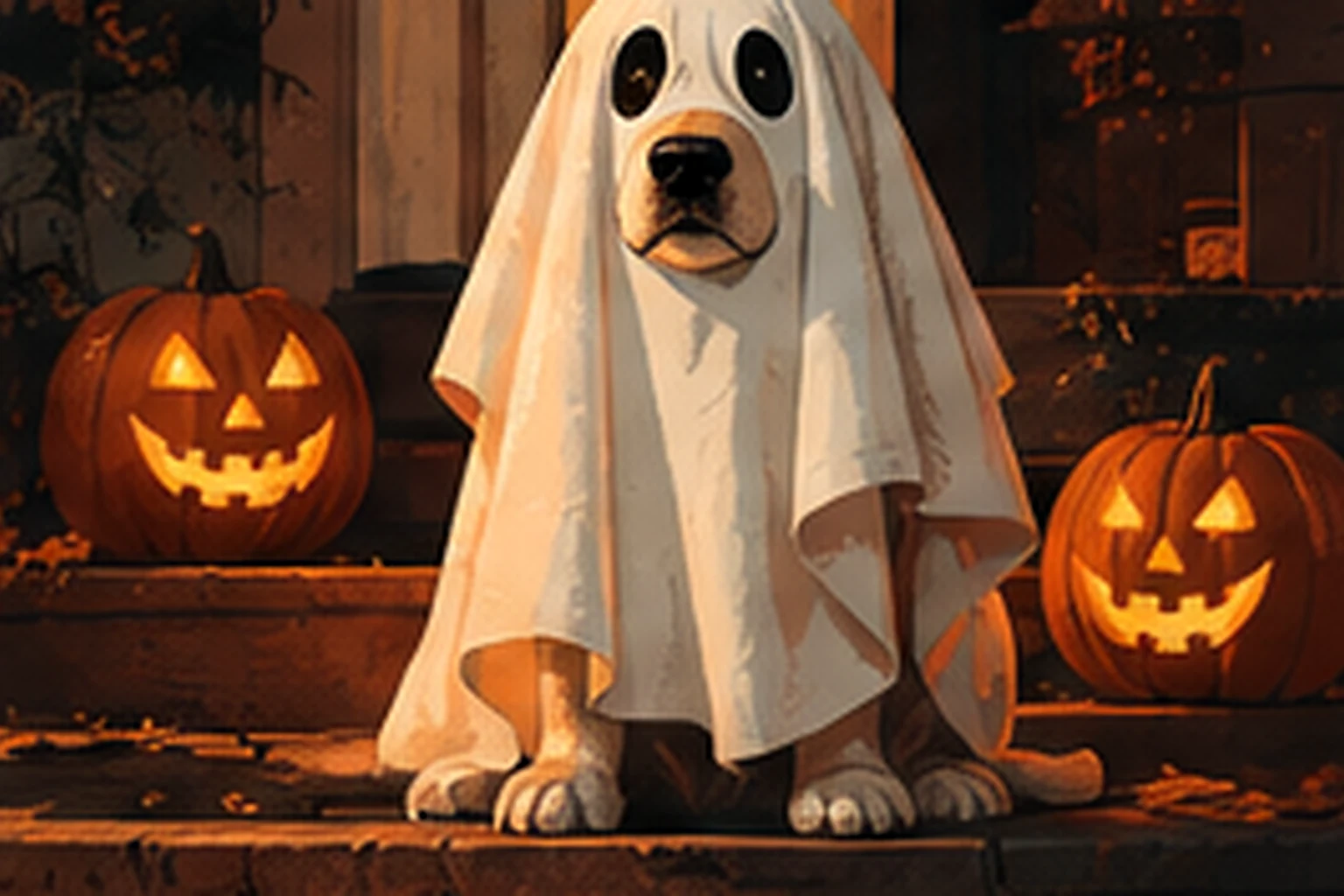
Milo had never understood Halloween, but he supported it without reservation. From his perspective the holiday involved strangers voluntarily opening their doors, people moving in friendly groups through the neighborhood, and an unusual increase in food-related activity. These were all developments he had been proposing for years. When his family announced that this October he would be going trick-or-treating in costume, Milo wagged his tail so enthusiastically that the kitchen chair shifted three inches across the floor.
The costume was a ghost. It consisted of a white cloth with eye openings, fitted carefully so that he could see, breathe, and walk comfortably. Milo's owner, Sam, had considered a tiny pirate jacket and a foam dinosaur, but the ghost was easier to wear and required fewer negotiations. Milo inspected the cloth once, decided it did not contain food, and returned to his more urgent concern: why the family was standing by the front door with a bucket and not yet going outside.
At the first house, a woman admired the costume and offered the children individually wrapped candy. Milo sat politely because he had been told to sit, and also because the bucket was at nose height. When no edible reward arrived for him, he tilted his head. Sam produced a dog treat from a separate pouch. The arrangement seemed fair, although Milo believed the neighborhood could improve efficiency by putting the dog food directly in the pumpkin-shaped container.
At the second house, a child wearing a werewolf mask barked at Milo. Milo barked back, delighted to discover a person who had finally learned the language. They exchanged several cheerful observations before Sam suggested continuing. The child had been trying to sound frightening. Milo interpreted it as a promising beginning to a friendship and attempted to follow him home.
The third porch featured an animatronic skeleton that rose from a chair whenever someone approached. It lifted a bony hand and shouted something about returning from the grave. The children shrieked. Milo stepped forward, examined the skeleton, and wagged his tail. Here was an unusually thin person who appeared to need company. He offered the skeleton his nose. The mechanism activated again. Milo wagged harder. It was the most enthusiastic greeting the decoration had received all evening.
A neighborhood costume judge, stationed beside a table of cider, announced that the dog was adorable. Milo understood none of the words but enjoyed the tone. She asked Sam to pose him beside a cardboard cemetery for a photograph. Milo complied for half a second before noticing a leaf tumble along the pavement. The leaf was either alive or in need of rescue. He lunged, became briefly entangled in the costume's hem, and emerged facing the wrong direction. The judge captured the moment on her phone and called it expressive.
As the evening continued, Milo noticed a troubling inconsistency. Some households handed out treats generously; others displayed signs explaining that the candy was gone. A few doors remained shut despite the presence of perfectly good people on the other side. Milo accepted that humans had complicated social rules, but he could not see why the simplest holiday in the world needed so many exceptions. A person who opened a door to greet a friendly visitor should, in his professional opinion, continue the greeting until someone became tired.
Sam had one rule that Milo struggled to understand: the colorful packets belonged to children, not dogs. Every time a sweet rustled, Milo offered the gentle, hopeful expression of an animal who believed property law should be reconsidered. Sam kept the candy bag closed and handed him a dog-safe biscuit when he needed a reward. Milo concluded that the household operated a complicated but ultimately fair two-currency economy.
His greatest triumph came at the final house, where an older man sat on the porch with a basket of candy for children and a small container of biscuits for dogs. Milo recognized the biscuits immediately. He sat without being asked, offered a paw, and remained still long enough to astonish his family. The man laughed and declared him the evening's best ghost. Milo accepted this honor with the calm dignity of a dog who had no idea what it meant and was mainly focused on the biscuit.
Back home, the children counted their candy and argued about the relative merits of chocolate bars and fruit chews. Sam carefully put the sweets out of Milo's reach, checked that no wrappers were on the floor, and removed the ghost costume. Milo curled up beside the sofa, content after an evening of walking, greeting, smelling, and receiving safe treats. Humans had spent weeks choosing costumes, buying decorations, and worrying about whether the holiday would be memorable. Milo's review was simpler. There had been people. People had been pleased to see him. The world was full of interesting smells. He was ready to do it again tomorrow.