
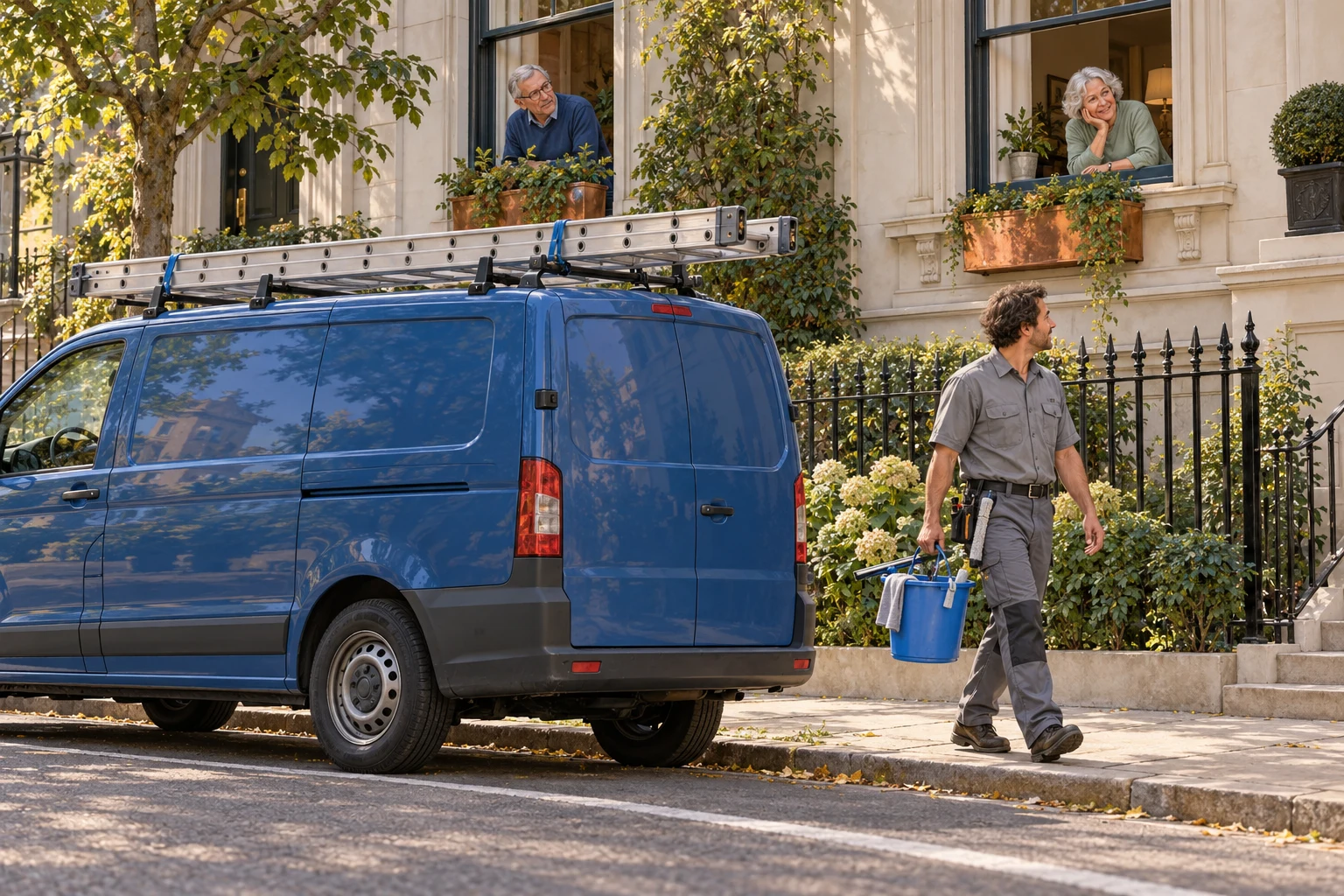
At 8:12, Marianne posted a photograph of a blue van to the neighborhood group with the caption “Does anyone recognize this?” It was parked in a marked bay beside a tree. There were no visible occupants, no open doors, and no activity of any description. The absence of activity did not reassure the group. By 8:19, the van was “just sitting there.”
Dennis said he had seen it yesterday. Priya asked where. Dennis said near the shops, although he could not rule out the possibility that the van near the shops had been white. This was entered into the discussion as a possible second vehicle. Someone reacted with the worried face, which gave the investigation a little institutional weight.
Graham said the important thing was not to jump to conclusions. He followed this with three conclusions about why a van might be parked in a residential street. One involved deliveries. The other two required considerably more preparation than the driver appeared to have undertaken, unless parking and doing nothing were part of the preparation.
“Could just be someone working,” Priya wrote.
Marianne replied, “Absolutely. Just raising awareness.”
Awareness was now raised. Several people who had previously been getting on with their mornings went to windows to have some.
The field reports
At 8:31, Colin reported that the van had a ladder. He attached a photograph taken from behind a curtain. The ladder was strapped to a roof rack. Colin had enlarged the photograph until the straps looked faintly significant. Graham asked whether anyone could see a business name. Colin said no. In fact, his photograph showed the tree rather better than it showed the van, but the tree had not yet come under suspicion.
Ruth, who lived in the building opposite, said there was a man nearby with a bucket. This should have reduced the number of plausible explanations. Instead, the bucket became a separate fact awaiting interpretation. Dennis wanted to know what was in it. Ruth said she was not close enough to tell and would not be approaching it, which sounded sensible enough to receive four supportive reactions.
Meanwhile, Priya had posted a photograph of a window-cleaning flyer that had been delivered the previous week. It showed a blue van. The photograph was not identical to the van outside because the van outside was turned the other way. Graham noted this difference. Priya said that vehicles could be turned around. The group paused to consider the practical implications.
At 8:47, Marianne wrote that she did not wish to alarm anyone. She put a full stop after “anyone,” which made the announcement feel grave. Below it, she added that the man had now gone out of sight.
He had walked around the building. Unfortunately, walking around a building is one of those actions that can sound purposeful when described by a person holding a phone beside a curtain.
A useful complication
At 9:02, the man returned to the van and removed a squeegee. Colin photographed the squeegee. The photograph was clearer than his earlier work and showed promising development in his observational technique. The group now had a bucket, a ladder, a squeegee, and a flyer advertising window cleaning, but remained reluctant to close the case too early.
“Has anyone actually booked him?” Graham asked.
Three people said they had not. This information was accurate and of limited relevance, but it gave the discussion the reassuring rhythm of a survey. Dennis said his sister had once had trouble with a contractor. The contractor had been a roofer in another town. The connection was that both men owned equipment.
At 9:11, a new message appeared from Helen at number eighteen.
“He’s cleaning my windows.”
There was a short silence. Then Marianne wrote, “Thanks Helen, that’s useful to know.”
Graham asked whether he had come recommended. Helen said yes, by Marianne.
Marianne did not immediately reply. During this pause, several members discovered urgent responsibilities elsewhere. Dennis posted a photograph of a robin on his fence. It was a decent photograph, and the robin provided a welcome change of suspect.
Community confidence
At 9:24, Marianne remembered. She had recommended the window cleaner after seeing his work at her friend’s house. He normally used a smaller vehicle. The blue van was new. The group agreed that this explained the confusion, although most of the confusion had not been about the age of the van.
Priya suggested that, next time, they might ask the person carrying the cleaning equipment. Graham said it was important that residents felt comfortable sharing concerns. This was true. Priya said it was also important that window cleaners felt comfortable cleaning windows. This was harder to express with a single reaction, so people used thumbs-up for both.
At 9:38, Helen asked the man whether he had room for another booking. He said he might, depending on the number of windows. Within fifteen minutes, the window cleaner had become “a lovely local business,” and the group was coordinating a possible discount. Colin offered to take a photograph for the recommendation, although the man said he already had one.
The van left at 10:06. Nobody found this suspicious. By then it had appointments to return on Thursday, and the group had moved on to whether the city had collected the wrong recycling bins.
At 10:14, Dennis posted a second photograph of the robin. It was taken from the same angle and might have been the same photograph. Nobody questioned it. The neighborhood had done enough identifying for one morning.