
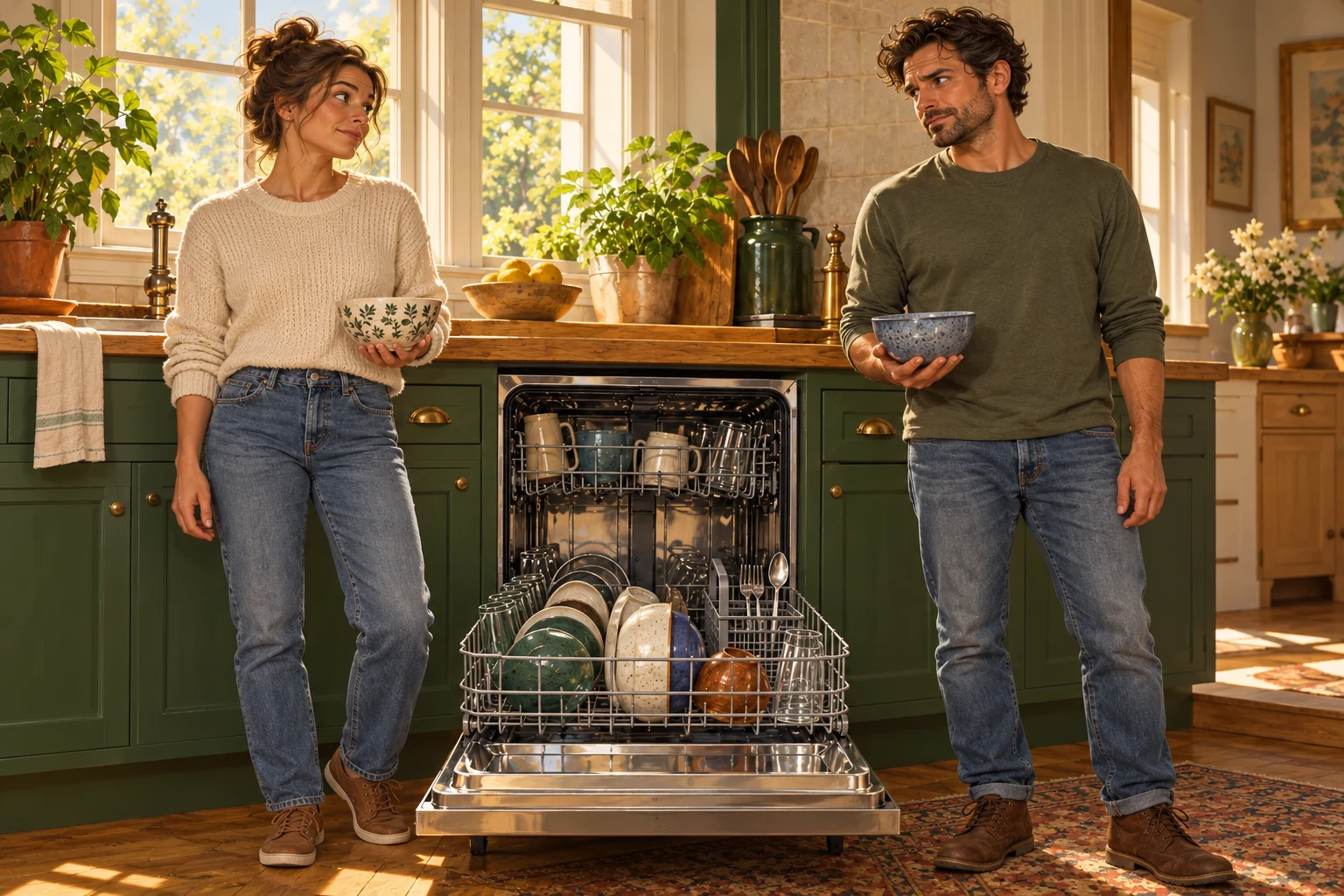
Eli had loaded the dishwasher and was already enjoying the private moral improvement that follows doing a household job without being asked. He had wiped the counter as well, although not behind the kettle. Behind the kettle was a different jurisdiction. He closed the door with the small, satisfying click of a person who believed an activity had ended.
Nora opened it. She did not say anything immediately, which gave the contents time to testify. Then she moved a bowl three inches to the left. Eli stopped in the doorway. The bowl had been functioning perfectly well where it was. Apparently it now required a new position and a witness.
“Just making space,” she said.
“There was space.”
“There was the idea of space.”
He returned to the kitchen. He did this casually, in the manner of a person who happened to be interested in standing beside a dishwasher he had just finished loading. Nora lifted a small plate out of the lower rack and inserted it between two larger plates. He watched her do it with the expression of an architect seeing a visitor knock through a wall.
His system was based on putting each item in a place where it would remain until it was clean. Her system involved angles, access, and the emotional wellbeing of the spray arm. She turned a bowl toward the center. He explained that he had turned it away from the center to accommodate a larger bowl. She moved the larger bowl. He picked up the smaller one. Within a minute they were both holding crockery, and the machine contained less than it had when the discussion began.
“The water comes from there,” Nora said, pointing.
“Water moves.”
“Yes. That is the feature I’m trying to preserve.”
Eli looked into the machine. It was difficult to argue with water without sounding unreasonable, so he examined the cutlery basket instead. There was a spoon lying diagonally across two compartments. This was Nora’s spoon. He knew because he had loaded his spoons vertically, like a person contributing to civilization.
“What’s happening here?” he asked.
“It was too long.”
“So it gets a special arrangement?”
“It’s a serving spoon, Eli.”
He repeated “serving spoon” quietly, as though a title had been granted without the proper process. Nora placed her bowl on the counter and folded her arms. The spoon remained diagonal. It had no intention of helping either of them.
They had owned the machine for four years. During that time it had cleaned thousands of objects under both administrations. This inconvenient record of practical success had never prevented either person from believing the other’s approach was one badly positioned mug away from catastrophe.
Eli proposed reading the manual. Nora agreed too quickly. He had hoped she would say there was no need, allowing him to win on the strength of being willing to consult a source. Instead she fetched the manual from the drawer containing batteries, instructions, and a small plastic part neither of them had dared throw away.
The manual showed a lower rack arranged with such breathtaking cooperation that Eli disliked it immediately. Every plate was the same size. There were no enormous pasta bowls, no oddly shaped lid, and no glass container from a batch of soup that had slowly become a permanent resident of the refrigerator. The illustrated household appeared to eat three completely compatible foods.
“Our dishes are different,” he said.
“The water doesn’t know that.”
“Then why are we consulting its preferences?”
Nora laughed, which almost ended the disagreement. Unfortunately, while laughing, she moved his saucepan.
He had placed it at an angle to let water drain. She placed it at a different angle to let water enter. Both had an explanation involving water. Neither could close the door: while consulting the manual, they had propped a baking tray against the side of the rack and forgotten it.
They removed the baking tray. Behind it was a mug neither remembered loading. For a moment they looked at the mug with the professional disappointment of investigators discovering a third manager on the project.
“Let’s just finish it,” Nora said.
This was an excellent suggestion, and both of them agreed with it while continuing to move things. Eli found room for the saucepan. Nora found room for three mugs by relocating a glass. Eli relocated the glass back, because its new position interfered with a bowl. Nora took the bowl out. He took another bowl out, although nobody had asked him to, to demonstrate that flexibility was available on his side too. The counter was beginning to resemble dinner again.
They tried dividing responsibility. He would do the bottom rack; she would do the top. This created a brief period of productive activity, followed by a border dispute over a utensil extending upward from the basket. Nora said it would stop the top rack moving. Eli said the top rack did not need to move while the machine was running. She demonstrated that it did need to move while she was loading it. The utensil was removed and placed on the counter, where it joined the growing population of objects that had become too politically complicated to wash.
At last the door closed. They stood side by side and listened to the cycle begin. It made the usual noises, with no sign that it understood the significance of what had happened.
“See?” Eli said, although nobody had seen anything yet.
Two hours later, the dishes were clean. A teaspoon in the middle of the basket had a small patch of dried yogurt on its handle. Nora found it first. Eli saw her find it. Neither spoke. She washed it under the tap, he dried it, and they put it away with the quiet efficiency of two people concealing evidence from their own investigation.