
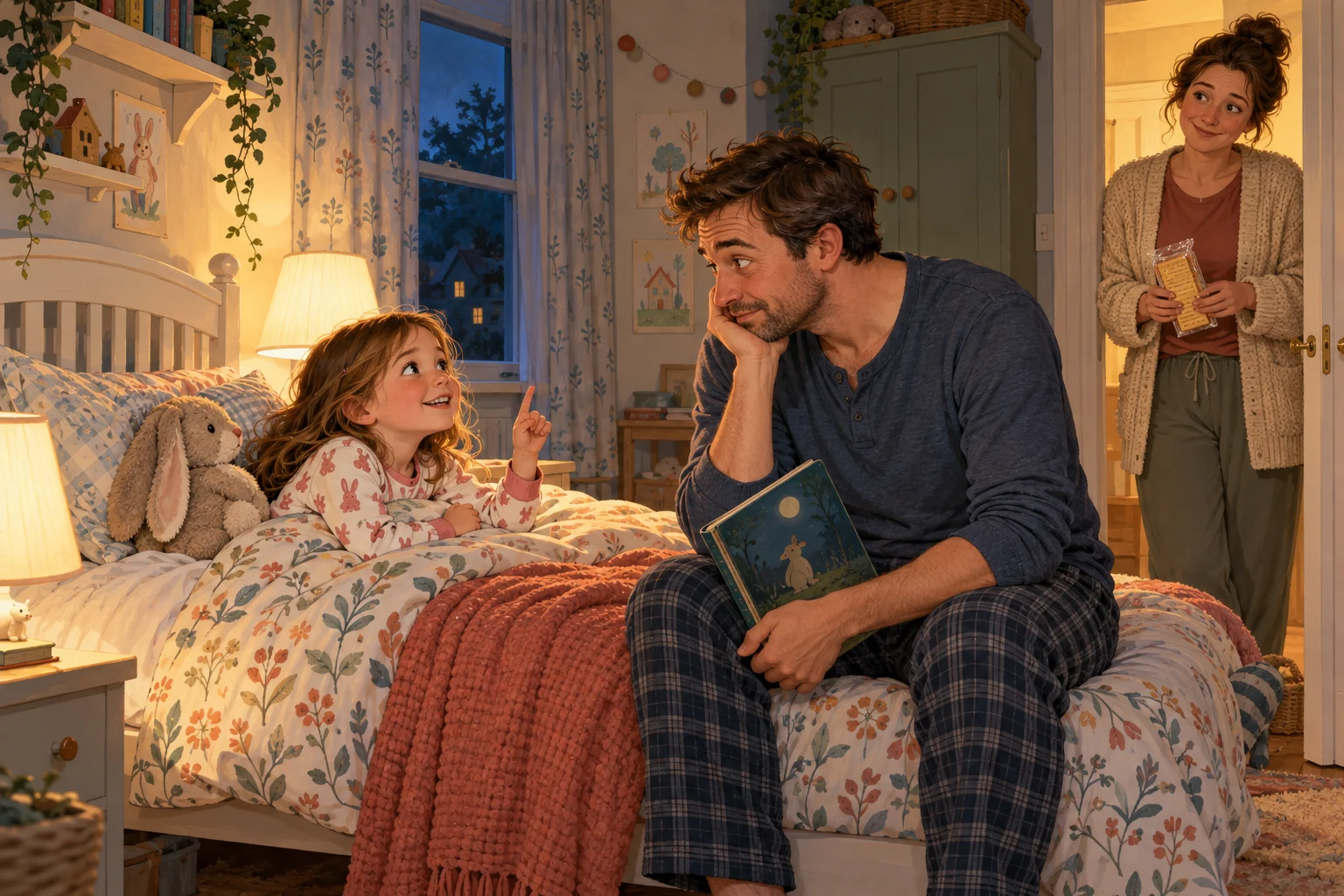
At seven thirty, we announced that it was bedtime. Our daughter thanked us for raising the matter and asked whether we had considered her proposal. We had not known there was a proposal. She said that was part of the problem with communication in this household.
The proposal was that she would stay awake until she felt tired. We explained that she was already tired. She explained that being told she was tired made her less tired. This was not a position we could test without giving her exactly what she wanted, a feature shared by many of her strongest arguments.
I offered the usual terms: teeth, pajamas, two stories. She countered with no teeth, different pajamas, and a story whose length she would determine after we started reading. My wife said the teeth were non-negotiable. Our daughter accepted this and immediately began negotiating which teeth.
We have books about parenting. Several discuss boundaries. None mentions the peculiar difficulty of maintaining one while a small person, wearing only one sock, asks whether you would prefer that she go to sleep sad.
Preliminary matters
The bathroom phase began well. She climbed onto the step, selected a toothbrush, and consented to water. Then she remembered she needed the other toothbrush. The other toothbrush was identical except that it had been emotionally available to her on a previous occasion.
We found it. She needed a drink. We provided a cup. This was not her bedtime cup. I asked which cup was her bedtime cup. She looked disappointed that, after years of living together, I still required this level of supervision.
By eight, she was in pajamas. The pajamas featured rabbits, one of which she believed looked worried. We discussed the rabbit. My wife suggested that the rabbit was probably sleepy, perhaps hoping it might set an example. Our daughter said it might need a snack. I could see the connection being built in real time and was powerless to stop it.
“You've already had a snack,” I said.
“The rabbit hasn't.”
This was accurate. I had no record of feeding the rabbit.
The reading period
The first story went smoothly until she asked why the bear lived alone. I said perhaps he liked a quiet house. My wife looked at me. I added that he also enjoyed visiting his many friends. Our daughter wanted to know whether his mother missed him. The bear's housing arrangement occupied us for eleven minutes.
For the second story, she chose a book about vehicles. This seemed a safe choice until we reached the excavator and she asked where it slept. I said a garage. She asked whether the garage was dark. I said probably. She asked whether anyone stayed with it. By then I would have agreed to move in with the excavator myself if it advanced the evening.
At the end, she requested one tiny extra story. She held her fingers very close together to demonstrate its size. I read a short poem. She asked what happened next. I said it was finished. She said it didn't sound finished. We sat with that assessment. I have received less discouraging editorial feedback from adults.
The final arrangements
Lights out introduced a new set of practical concerns. The door needed to be open, but not that open. The blanket needed to cover her feet without pressing on her toes. The stuffed rabbit needed to face her, but its expression suggested it wanted to face the wall. We found a compromise in which the rabbit looked toward the wardrobe and assumed responsibility for its own feelings.
I sat beside the bed. She asked if I would stay until she fell asleep. I said I would stay for five minutes. She asked how long five minutes was. I explained. She asked how long until the five minutes started. I realized we were still in preliminary discussions.
My wife had gone to the kitchen. From there came the sound of her opening a packet. Our daughter sat upright with the precision of a small animal detecting weather.
“What was that?”
“Nothing.”
“It sounded like something.”
“It was a packet.”
“What was in it?”
I considered lying, but there were crumbs in my future and she would find them. “Crackers,” I said.
She lay back down. “I thought so.” There was no anger in her voice. Merely the quiet disappointment of a person discovering that the adults had reserved a second, better evening for themselves.
At eight forty-six, she fell asleep holding my finger. I stayed a little longer than necessary because her face had softened into the one that makes the entire difficult arrangement feel like extraordinary good fortune. Then I carefully withdrew my hand, stood up, and stepped on a small plastic giraffe.
She opened one eye. “Are you leaving?”
“Just to the kitchen.”
She considered this. “If you see the crackers,” she said, “tell them I asked.”