
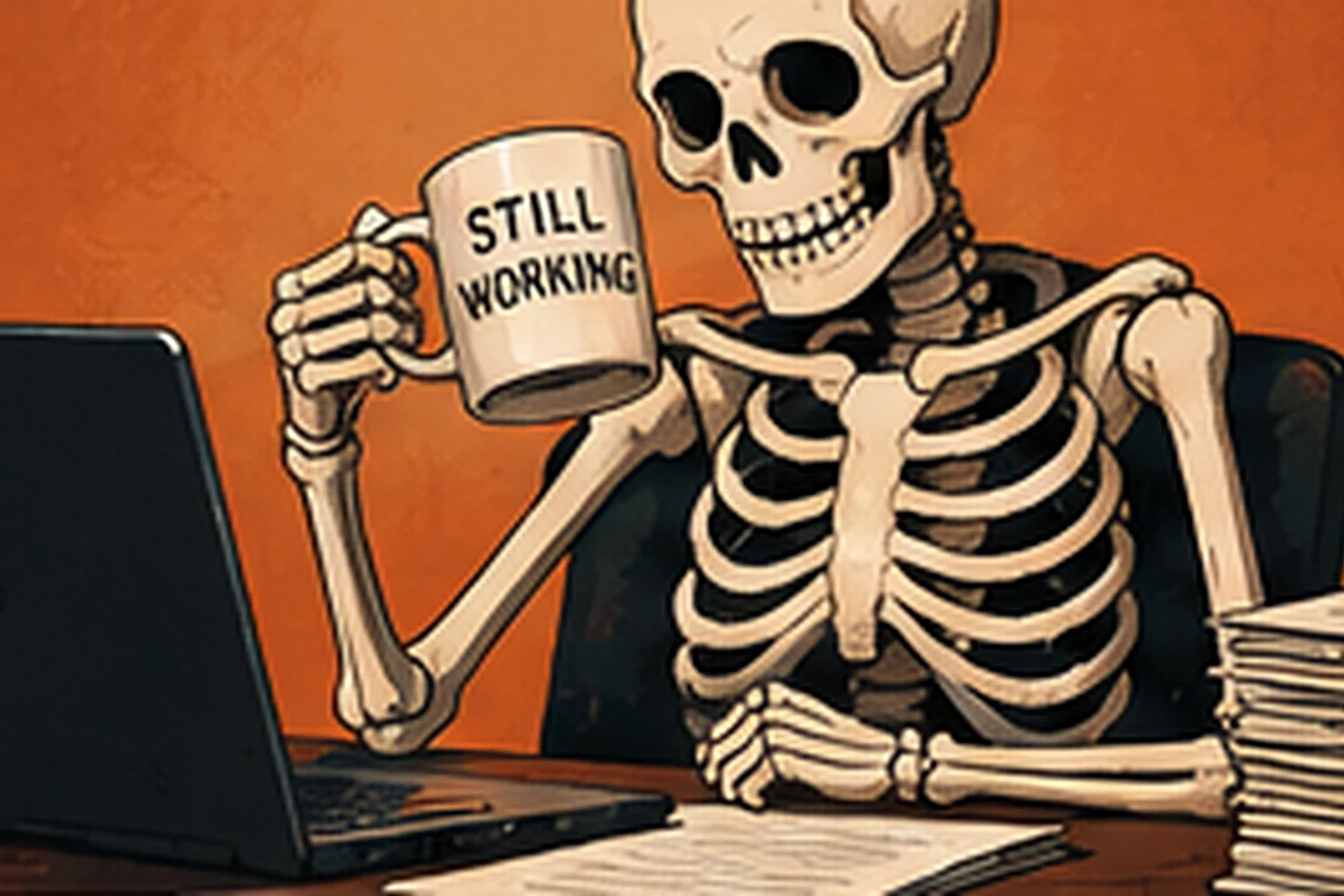
Martin died on a Thursday in late September, which was inconvenient because the quarterly review was scheduled for Friday. He discovered this when his phone chimed on the table beside him at the funeral home. His body had been prepared for viewing, but his consciousness, for reasons that neither medicine nor theology had adequately anticipated, remained attached to the same calendar notifications. The screen lit up with a message from his manager: Quick question before tomorrow's meeting. Martin had expected a tunnel, perhaps a radiant light. Instead he had received a request to check the figures in column H.
His manager, Denise, was sympathetic in the efficient way of someone who had already postponed the review twice. She wrote that everyone understood he was experiencing a significant personal transition. Martin appreciated the delicacy of the phrase; it avoided the uncomfortable fact that he had stopped experiencing a pulse. She wondered whether he could still send the spreadsheet, because finance had promised a revised forecast by eleven. The request arrived with a tiny smiley face, as though that might make it less troubling.
I am dead, he replied. Denise reacted with a thumbs-up. A few minutes later she sent another message: Understood. Should I mark you out of office or working remotely? Martin considered the possibilities. His body was in a funeral home. His voice seemed to travel through electronic devices. In a technical sense, there was no office he could reasonably be expected to attend. He selected Remote and immediately received an automated reminder about maintaining an appropriate workspace. He glanced at the polished wooden table beside the viewing room and wondered whether it met the company's ergonomic standards.
On Friday he joined the review as an audio-only participant. Denise introduced him by saying that he was 'working through a personal matter' and asked everyone to respect his privacy. This seemed generous until she shared a slide titled Building Momentum for the Future and requested Martin's forecast. He gave the forecast because he had spent thirty-seven years being the person who knew where the numbers lived. He could not remember his own final words to his family, but he remembered precisely which spreadsheet tab contained the budget variance.
At the funeral on Saturday, his daughter placed a photograph of him fishing beside the flowers. The picture showed a version of Martin who had once ignored a ringing phone for nearly four hours because the river was beautiful. He studied it with astonishment. There had been a time when he knew how to do that. The next afternoon Denise sent condolences on behalf of the team, followed by an invitation to a meeting about redistributing his tasks. It seemed the organization was prepared to acknowledge his absence in principle, provided his presence remained available in practice.
The afterlife turned out to have its own informal network of people with unfinished professional business. A retired insurance clerk had spent decades waiting for reimbursement on a train ticket. A former school administrator was still receiving updates from a committee she had left in 1987. On Tuesday evenings they gathered beneath a cemetery oak and compared the astonishing longevity of routine paperwork. Nobody talked about eternity. They talked about approval chains. Martin wondered whether the reason ghosts remained among the living was not unresolved grief but an expense report requiring a manager who had also died.
By the middle of October he had become Senior Continuity Advisor, a title offered by Human Resources after it concluded that his status did not fit an ordinary employment category. He received no salary, because payroll considered the matter unprecedented, but he did receive an employee-recognition certificate. His daughter placed the certificate beside his urn. It thanked him for showing commitment beyond expectations. She read it twice and said it was the first piece of corporate language about her father that appeared literally true.
During planning for the office Halloween event, Denise suggested Martin might attend in costume. Perhaps, she said, he could dress as a skeleton. The chat filled with laughing emojis. Martin had been trying to establish his identity as a thinking, feeling person despite the inconvenience of being dead; becoming a seasonal decoration seemed a step backward. He replied that he might come dressed as a tax accountant instead. Nobody found that funny. This confirmed his suspicion that the living were less comfortable with reality than they claimed.
The company's urgent productivity workshop arrived a week later. A consultant explained that the organization needed to work smarter, reduce burnout, and cultivate a culture of healthy boundaries. Martin watched seventeen employees take notes about boundaries while their phones delivered new work requests. When the consultant asked for proposals, Martin raised his translucent hand. He suggested a straightforward policy: when an employee dies, their duties should pass to a living employee. The room went quiet. Denise said the proposal would need legal review and a cross-functional steering committee.
Martin finally understood the trap. In life, he had been rewarded whenever he made himself impossible to replace. In death, he had discovered the achievement could become permanent. He opened the spreadsheet, wrote a clear handover note, assigned his remaining tasks to named colleagues, and made a folder that could be understood without summoning him from the grave. Then he sent one last email: I have finished my work. You can finish yours. He switched off his phone. The silence was magnificent. For the first time since Thursday, the afterlife seemed to have room for an actual afterlife.