
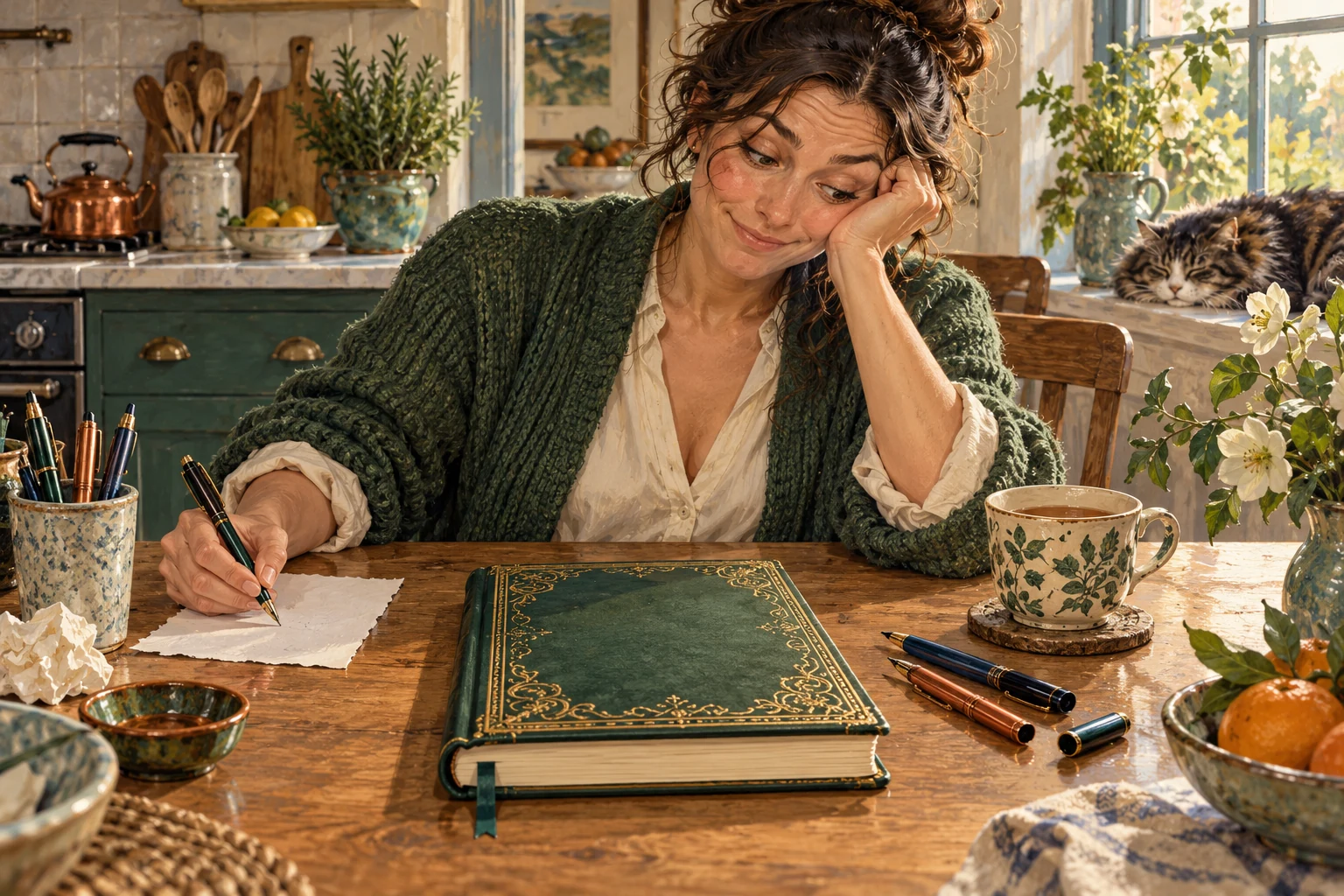
The notebook cost more than I had intended to spend on paper, but it was not really paper. It was the place where the next version of me would begin making sense. The cover was a serious dark green, the pages were thick, and the binding allowed it to lie flat, which was one more commitment to useful behavior than I had made that week.
In the shop, I imagined writing in it at a clear desk beside a window. I would have one pen, a glass of water, and a plan expressed in language that did not require the phrase “sort this out.” In this picture, I had somehow become someone who knew where the scissors were.
I bought a pen as well. It seemed unreasonable to ask a new life to begin with the free one from the dentist.
At home, I cleared a space on the kitchen table. This required moving a bag, two receipts, and a small screw whose origin was uncertain enough to justify keeping it. I put the notebook in the middle of the table. The effect was immediate. The room looked as though somebody in it was about to become organized.
I opened the first page. It was extraordinarily blank. Ordinary paper says, “Write something.” Expensive paper says, “Before you do that, are you sure?” I held the pen above it and considered a heading. Goals was too broad. Plans suggested a certainty I could not support. Things To Do had the ugly honesty of the situation and therefore did not belong on the first page.
I decided to write the date. Unfortunately, I was unsure whether I wanted to use numbers or spell out the month. Either choice would establish a style I might have to maintain for the entire notebook. I closed it so that I could think about this without the page watching.
By lunch, I had researched three systems for using a notebook. One involved an index. Another involved symbols. A third promised simplicity, but the person explaining it had made a forty-minute video and was selling a companion ruler. I watched eighteen minutes and began to feel that my stationery had a training requirement.
On Wednesday, I wrote my name inside the cover. This was a modest action with a pleasing sense of ownership. I immediately wished I had centered it better. The pen had produced a small flourish on the last letter, suggesting a confidence I had not authorized.
I considered starting on the second page. The first could be reserved for something important. Then I realized that reserving the first page would make the second page the first actual page, which returned the problem with the added burden of a deliberate omission. I went to make coffee.
While the kettle boiled, the plumber called. He asked me to check the width of the cupboard under the sink and said he would come on Friday between ten and twelve. I measured it, read the number to him, and wrote both the width and the appointment on the back of an envelope because it was nearby. The envelope accepted the information without any questions about my ambitions. It already contained a grocery total and the words “blue thing upstairs,” which had once been sufficient instructions to myself.
The notebook remained open on the table. I put the envelope beside it. The two objects seemed to represent different schools of thought.
My partner asked whether the notebook was for anything in particular. I said I was developing a system. She said that sounded useful and asked whether I had written down the plumber’s time. I showed her the envelope. She looked at the notebook, then at the envelope, and exercised the restraint that has sustained our relationship through several previous purchases of a better future.
I told her I did not want to fill the notebook with random things. She asked what kind of things I wanted to fill it with. I said things that belonged there. This was accurate, if not particularly available for independent interpretation.
That evening, I used a piece of scrap paper to design a layout for the notebook. There would be a weekly overview, a place for ongoing projects, and perhaps a small area for reflection. I drew boxes. I made one too narrow and crossed it out. The scrap paper began to look like the inside of a working mind, which was exactly the sort of appearance I was trying to keep away from the notebook.
On Friday, the plumber arrived at eleven. I could not find the envelope. It had been moved from the table during a brief and regrettable attempt to make the kitchen look pleasant. The plumber wanted to confirm the width before ordering the part. I pointed to the cupboard and offered him the tape measure. We established the same fact for a second time, using a system that required a qualified tradesperson to be standing in my kitchen.
After he left, I opened the notebook and wrote: “Plumber coming back Tuesday. Ask about the other tap.” I wrote it on the first page, under a date whose format I selected without consultation. My pen left a tiny mark where my hand rested. Then I wrote down the part number he had given me, and underneath it, a reminder to buy onions.
The page looked used. Nothing about it could have been sold in the shop as a photograph of my improved life. It was also the first page I had produced that week which had a reasonable chance of helping me on Tuesday.
I put the pen inside, closed the notebook, and left it by the kettle. My partner saw it later and asked how the system was going.
“Early results are promising,” I said.
Then I opened it again and added milk. The onions had made the place feel surprisingly welcoming.